Does your organization already use AI models or intelligent agents, but you don’t know exactly who consumes them, how much they really cost, or how to set security limits in production?
Without a central point of control, model calls become scattered, costs grow unpredictably, security weakens, and observability disappears.
The AI Gateway is an essential enterprise solution in this context: a layer designed to manage, secure, and optimize interaction between artificial intelligence applications, agents, and APIs.
In this article, we will look at what exactly an AI Gateway is, what problems it solves compared to a traditional API Gateway, what its most significant benefits are, and what platforms and best practices enable it to be adopted securely in modern environments.
What is an AI gateway?
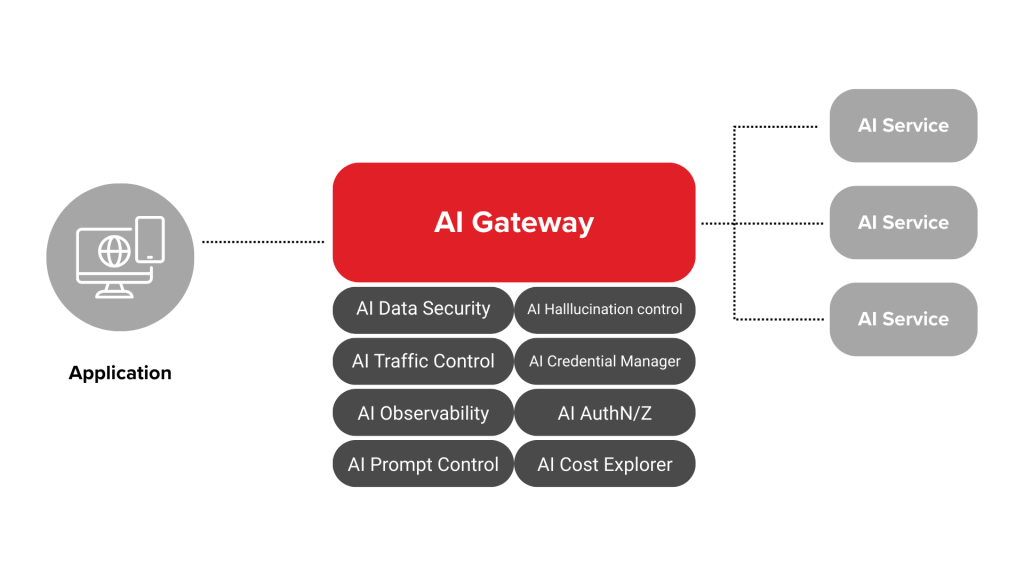
An AI Gateway is a specialized middleware platform that acts as a centralized point of connection, control, and management between applications and language models (LLMs), AI APIs, and intelligent agents.
Thus, its main objective is to simplify and govern interactions with these systems through a unified interface, applying security policies, access control, intelligent routing, observability, and AI workload management.
AI Gateway
What specifically does an AI Gateway do?
Un AI Gateway actúa como puente entre las aplicaciones de usuario y los distintos modelos de IA o servicios de inferencia que puedas tener desplegados (propios o de terceros), proporcionando las siguientes funciones:
An AI Gateway acts as a bridge between user applications and the various AI models or inference services you may have deployed (your own or third-party), providing the following functions:
- Multi-level integration and orchestration
Allows you to integrate multiple AI models or services without each application having to connect individually to each provider, simplifying the architecture. - Centralized security and governance
Applies consistent authentication, authorization, and usage policies across all AI access points. - Traffic control, observability, and AI-specific metrics
Provides token usage, error, and cost metrics, as well as features such as caching and rate limiting designed for AI workloads. - Intelligent routing between models and services
In environments with multiple LLMs or instances, you can direct requests to the most appropriate model based on cost, latency, or other policies.
In contrast to an API Gateway, which is designed to route general-purpose API requests (e.g., REST or HTTP) and apply basic security and scaling rules, an AI Gateway handles the specific characteristics of AI workloads, such as context flow, token quota negotiation, semantic routing, and governance policies tailored to artificial intelligence models.
You may be interested in the following article: Identity and Access Management (IAM) – The Critical Security Foundation
Example
Imagine an omnichannel customer service application (chat, email, or WhatsApp) that uses different AI models: one to generate responses, another to detect sentiment and intent, and another to analyze images (for example, a photo of a damaged product or a receipt).
An AI Gateway can:
- Receive the request from the application (message, attachments, and customer context).
- Classify the request to identify what type of AI is needed (LLM, image recognition, sentiment analysis).
- Orchestrate the flow by sending each part to the most appropriate model.
- Apply policies in a single layer: authentication, rate limiting, token cost control, and auditing.
- Unify the final response (suggested response, recommended tone, and image analysis result) and return it to the application.
The AI Gateway allows your teams to treat artificial intelligence as a single service, rather than a collection of heterogeneous integrations of AI models and agents in production.
Benefits of implementing an AI Gateway
One of the main benefits of the AI Gateway lies in its ability to centralize access to intelligent models and services, as well as to govern, secure, and optimize their use in a consistent, measurable, and scalable way. Below, we explain each benefit in detail.
Advanced security and authentication
When working in environments with many applications and agents that use AI models, we cannot leave security scattered across each service: it must be managed centrally and consistently.
The AI Gateway acts as a single point of control where access and authentication rules are applied to protect AI resources, just as an API Gateway does for traditional APIs, but adapted to the risks specific to AI workloads.
This translates into:
- Centralized authentication and authorization, preventing each application from implementing its own keys or mechanisms.
- Protection against unauthorized access and model abuse.
- Access logging and auditing that facilitate compliance with security policies.
OWASP (Open Web Application Security Project) highlights how important it is to protect artificial intelligence APIs against new threats. That is why they have launched a global initiative called the OWASP GenAI Security Project, focused on identifying and addressing various vulnerabilities present in applications based on language models (LLMs).
Optimizing API management with AI
An AI Gateway allows you to manage traditional APIs and AI APIs or endpoints from a single point, providing a unified view of service usage, errors, latency, and behavior, without having to instrument each one separately.
You may be interested in the following article: QA Automation in your APIs with artificial intelligence
Integration with AI agents, MCP servers, and LLM models
AI agents (programs that act autonomously using AI) and LLM (Large Language Models) require orchestration to handle requests that are distributed across different services or contexts.
An AI Gateway enables:
- Orchestration of calls between different LLMs or AI engines according to business or cost rules.
- Control and management of automated agents that access the same resources.
- Support for standardized protocols such as MCP (Model Context Protocol), which help formalize how agents consult tools and context.
An AI Gateway becomes even more important in this context because it centralizes the control of agents and models, avoiding common scenarios such as:
- Agents “out of control”: agents that execute too many actions or loop calls, generating overload and excessive consumption.
- Exposure of sensitive data: prompts or responses that include private or internal information without access control and traceability.
- Unpredictable costs: agents that trigger calls to expensive models without limits or centralized visibility.
Rate limiting
Rate limiting is the process of limiting how many requests a consumer (application, user, or agent) can send to an AI model per unit of time. Its importance lies in the fact that, if not implemented, costs can skyrocket and the risk of unintentionally sending large amounts of sensitive data also increases.
Cost control
AI models are often billed based on consumption (tokens, computing time, etc.). Without a central point for measuring and limiting that consumption, a poorly designed integration can lead to unexpected bills or budget imbalances.
An AI Gateway can:
- Track token usage or inference time by application or client.
- Set spending limits or automatic alerts.
- Direct requests to more efficient alternative models when applicable.
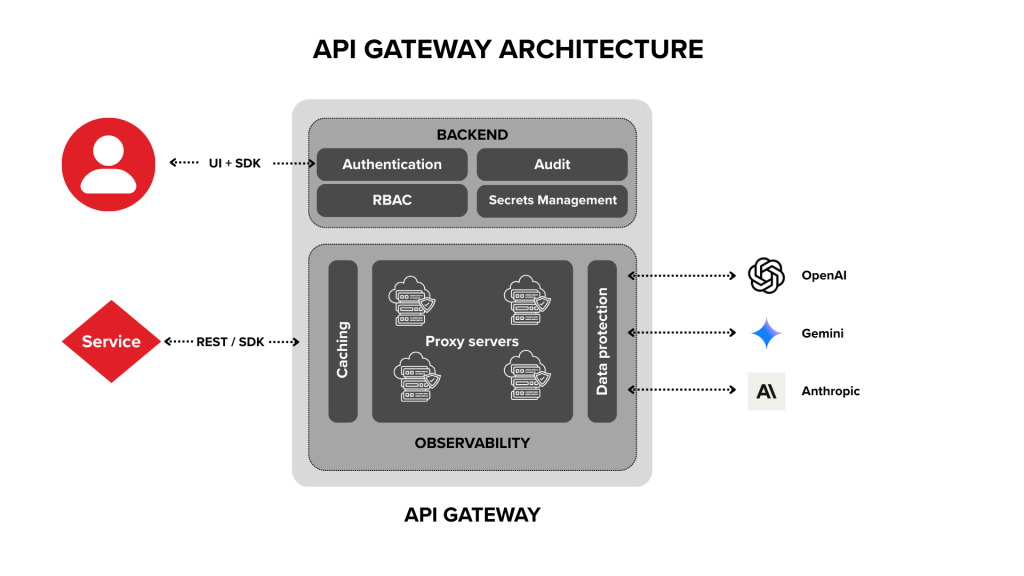
API Gateway Architecture
API Gateway vs AI Gateway
We may have already touched on this briefly in previous points, but specifically: How much difference is there between a traditional API Gateway and an AI Gateway?
First, let’s start with a brief summary of both concepts.
What is an API Gateway?
An API Gateway is a central entry point for an application’s APIs. Its main function is to receive, route, and control API traffic, while also applying policies such as security, authentication, rate limiting, and message transformations.
For example:
- An API Gateway manages HTTP/REST traffic.
- It applies authentication (OAuth/JWT).
- It performs load balancing and routing.
- It records standard usage metrics.
On the other hand… What sets it apart from AI Gateway?
An AI Gateway can be seen as an evolution of the API Gateway. However, in addition to the traditional functions of an API Gateway, an AI Gateway offers:
- Understanding AI traffic: recognition of specific consumption patterns of models and agents.
- Orchestration of AI models: routes requests between different LLMs according to cost, latency, or quality rules.
- AI-specific observability: metrics such as tokens used, inference times, or costs per model.
- Integration of AI agents: monitors and controls autonomous agents that use AI.
- AI-tailored policies: rate limiting and cost control specific to model usage.
In summary: It adheres to the same principles and can be used in a similar manner, but expands its range of operability, incorporating artificial intelligence workloads and AI APIs as well.
Side-by-side comparison: API Gateway vs. AI Gateway
Below is a table summarizing the scope of each one:
| Feature | API Gateway | IA Gateway |
| API Management | Yes | Yes |
| Traffic Control | Basic | Intelligent and dynamic |
| Observability | Limited | AI observability (tokens, prompts, costs) |
| Security | APIs and services | APIs + AI agents |
| LLM Orchestration | No | Yes |
| AI Cost Optimization | No | Yes |
Does this mean that it is necessary to opt for an AI Gateway model instead of an API Gateway? The answer depends entirely on how much Artificial Intelligence is incorporated into your business architecture.
If you only need to route and control traditional APIs, an API Gateway is sufficient.
On the other hand, if you work with AI models, automated agents, or applications that rely on intelligent inferences, an AI Gateway offers specialized governance and optimization capabilities that an API Gateway does not provide on its own.
Recommended platforms and technologies
Below are some effective and reliable platforms and solutions that will allow you to manage, secure, and optimize traffic for your APIs, applications, and artificial intelligence models.
WSO2 AI Gateway
WSO2 API Manager is part of the WSO2 API Manager suite, an open source platform for API management and intelligent traffic.
This component is designed to centralize and govern AI traffic from a single point, applying security, usage analysis, and control policies.
What it offers:
- Integration with multiple AI providers (OpenAI, Google Gemini, Mistral AI, among others), allowing traffic to be routed and balanced between models.
- Cost control and observability, with usage metrics, latency, and traffic patterns to optimize operations.
- AI Guardrails and advanced security, with prompt validation, output control, and compliance.
- Agent management and MCP Gateway, which converts existing APIs into secure resources accessible by intelligent agents under a governed model.
- Rate limiting policies and token quotas to protect resources and prevent abuse.
Gravitee AI Agent Management
Gravitee is an open-source API management platform that has evolved to incorporate AI agent management capabilities and LLM policies into its management catalog.
Features:
- Agent Mesh: integrated suite that allows you to define, manage, and protect communications between intelligent agents using protocols such as A2A (Agent-to-Agent).
- MCP Proxy and LLM Proxy: layers that allow you to manage how agents consume AI services and models, with consistently applied policies and security.
- Access control, security, and observability for communications between agents and to/from AI models.
- Centralized agent catalog that facilitates discovery, governance, and control of interactions between agents.
Apache APISIX
Apache APISIX is a high-performance open-source API gateway that also serves as a foundation for extending AI gateway policies, thanks to its modular architecture and plugin capabilities.
What capabilities does it offer?
- A rich set of plugins for authentication, load balancing, rate limiting, observability, and security through an extensible architecture.
- Support for dynamic routing and hot-loading of plugins to adapt gateway behavior without restarting services.
- Scalability and optimal performance for API traffic loads and intelligent services, facilitating constructions where AI coexists with traditional APIs.
You may be interested in the following article: Apache Apisix: The high-performance cloud-native API gateway for microservice architectures
Kong AI Gateway
Kong AI Gateway is a solution designed to centrally manage, secure, and optimize traffic to AI models (LLMs) and associated resources such as MCP Servers. It is built on the Kong Gateway infrastructure and adds a set of specialized capabilities for AI use cases in production.
- Multi-LLM and unified provider: Allows you to integrate and route requests to multiple model providers (OpenAI, AWS Bedrock, GCP Vertex, and others) from a single API, simplifying adoption and allowing you to switch providers without modifying application code.
- Security and content guardrails: Integrates capabilities to moderate and protect content sent to models through guardrail policies, semantic checklists, and PII (sensitive data) sanitization, supporting compliance and reducing risks of inappropriate content or data leaks.
- RAG and MCP pipeline automation: Facilitates the construction of Retrieval-Augmented Generation (RAG) pipelines and the exposure/management of MCP Servers, allowing complex flows to be implemented and governed without the need to build support infrastructure from scratch.
- No-code and integrated plugins: Offer integration through plugins that do not require code (e.g., AI Proxy, Prompt Guard, Prompt Template), accelerating adoption and reducing the engineering burden of enabling AI policies.
Best practices for implementing an AI Gateway

- Start with critical routes and standardize access: First route the highest-impact LLM calls (core apps, internal agents) through the gateway to unify policies and observability without blocking the rest.
- Define consumption plans (by team or app) and apply limits by tokens and requests: Limiting by requests alone is not enough; also use token quotas to avoid cost spikes and unfair distribution.
- Enable caching where it makes sense (repeatable responses): For recurring prompts or queries, caching reduces latency and paid calls to the provider.
- Incorporate Guardrails as policy: Apply content/security controls (e.g., prompt classification) at the gateway to ensure consistency.
- Measure what matters in AI and turn metrics into decisions: Instrument operational and AI metrics (errors, latency, consumption) and use them to adjust routes, limits, and cache.
Use cases and examples

Below, we list some examples of AI Gateways applied in industries with the aim of improving processes through artificial intelligence.
These cases have been highlighted by Coralogix (observability tool), as well as by more technical and operational approaches documented by Apache APISIX (essential AI Gateway cases) and Solo.io (GenAI optimization in production):
- Healthcare — AI-assisted diagnosis (Coralogix): An AI Gateway allows a hospital or clinic to connect internal applications (e.g., a clinical viewer) with models that analyze medical images in a controlled manner.Instead of each system “talking directly” to the model, the gateway centralizes integration and facilitates the application of rules such as authentication, traceability, and usage control. This speeds up the flow because the app only consumes one endpoint and the gateway takes care of routing the request to the correct model..
- Finance — real-time fraud detection (Coralogix): In a bank or fintech, each transaction can go through an AI flow that detects anomalous patterns (e.g., unusual purchasing behavior or suspicious access attempts).The AI Gateway helps standardize this “AI step” as part of the authorization pipeline and provides operational control: who calls the model, how often, and how the event is logged for auditing. This prevents each team from implementing its own fraud engine without common control.
- Intelligent routing and resilience between models (Apache APISIX): when an organization uses multiple models (based on cost, accuracy, or availability), the AI Gateway can make real-time routing decisions.For example: simple queries (FAQs, basic classification) are sent to an economical model, while complex cases (legal drafting, advanced analysis) are sent to a more powerful model. In addition, if a provider degrades or fails, the gateway can fall back to another model, maintaining service continuity without having to modify each client application.
- Cost optimization with semantic caching (Solo.io): In internal assistants or support bots, many questions are repeated (“How do I reset my password?”, “What is the vacation policy?”).
With an AI Gateway, semantic caching can be implemented: if a new query is equivalent to a previous one, the system can reuse the response already generated instead of invoking the model again. This reduces latency, lowers token consumption, and makes AI more economically viable as user volume grows.
- Consumption control with rate limiting and budgets (Apache APISIX): when AI becomes part of critical processes, it also becomes a point of expenditure and risk. An AI Gateway allows limits to be imposed per user, application, or device (for example, “maximum X requests/minute” or “maximum Y tokens/day”).
This prevents a bug, a bad prompt, or intentional abuse from triggering consumption. It also makes it easier to operate AI as a governed service: with clear quotas, cost predictability, and centralized control without blocking each team’s innovation.
Frequently asked questions about AI gateways
The following questions have been answered by Alfredo Prats, Head of Technical Delivery at Chakray Spain:
What exactly is an AI Gateway?
An AI Gateway is a specialized middleware platform that facilitates the integration, management, and governance of artificial intelligence services—including language models (LLMs) and AI APIs—by connecting applications to these services through a central control point.
Does an AI Gateway replace an API Gateway?
No. It complements or extends it when AI services are incorporated.
Does an AI Gateway work with multiple AI providers?
Yes. Most AI Gateway solutions support multiple inference providers, including third-party models or internal clusters, enabling unified use without locking in to a single vendor.
Is it only for LLMs?
No. It also manages AI agents, intelligent APIs, and AI microservices.
Can an AI Gateway integrate with existing enterprise services?
Yes. Many AI Gateway platforms are designed to integrate with existing enterprise infrastructures (such as public cloud API Management) and apply security and governance policies that you already use in your systems.
Why do I need an AI Gateway if I already have an API Gateway?
Although an API Gateway manages general API traffic, it is not optimized for AI workloads. An AI Gateway offers specific features such as:
- Observability of AI metrics (tokens, inferences).
- Management of multiple AI models.
- Policies tailored to agents and AI consumption.
Conclusion
An AI Gateway is the most important piece for scaling the use of LLMs, AI agents, and intelligent APIs in production. Among its highlights, it centralizes security, observability, and control, as well as facilitating integration between applications and multiple providers and models.
If you want to evaluate your options and platforms for incorporating AI into your organization, Chakray can advise you. Contact us today and take the next step toward secure, scalable, and controlled AI adoption.