Does your organization have many APIs, but no one knows exactly which ones exist, who is responsible for each one, which version is in production, or whether they comply with security standards?
This is one of the most common problems in environments where microservices, external integrations, or API-oriented architectures are implemented as the base structure.
As teams grow and publish APIs autonomously, recurring problems arise: redundancies, insecure APIs, outdated documentation, incompatible versions, and high maintenance costs. This phenomenon is also known as API sprawl and is one of the main reasons why organizations lose control over their digital ecosystem.
The solution? An effective, centralized API governance strategy.
In this article, we will guide you through a step-by-step explanation of what API governance is and how it can be applied effectively and practically, ensuring it does not hinder your team’s autonomy.
What is API Governance and why does it matter?
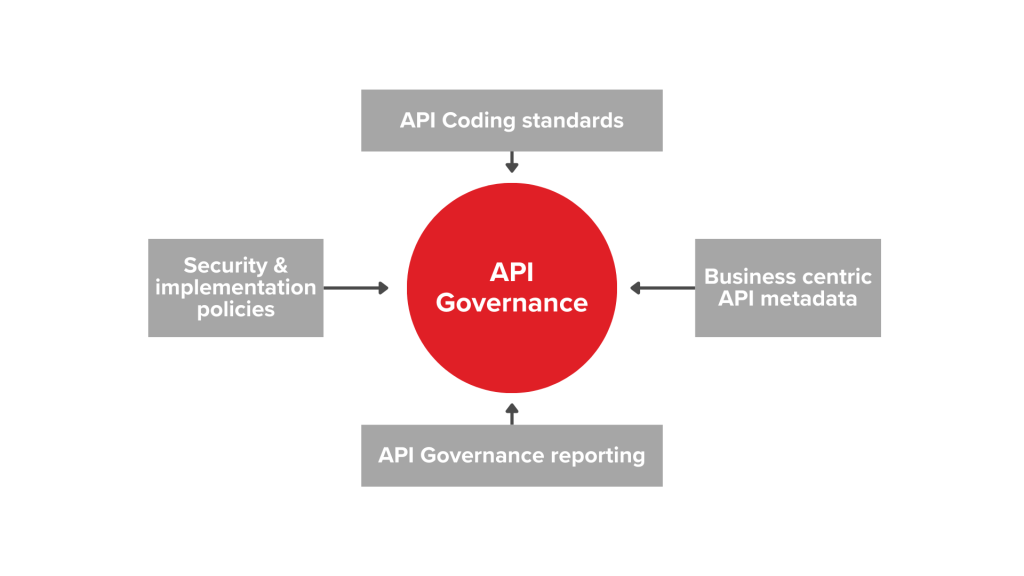
API Governance is the framework of policies, standards, and processes that defines how an organization designs, develops, publishes, maintains, and retires its APIs in a consistent, secure manner that is aligned with business objectives. Its purpose is to ensure that APIs are consistent, reusable, secure, and easy to consume for internal and external teams.
API Governance is not limited to documentation and rules: it promotes consistency across the API ecosystem so that different teams follow common standards and align APIs with the organization’s overall strategy. This ensures that APIs contain the necessary metadata, are secure, and facilitate integration between heterogeneous systems.
Why is API governance important?
- Organizational consistency: Helps ensure that all APIs follow common standards (naming, versioning, documentation), facilitating their adoption and maintenance.
- Reduction of API sprawl: Prevents redundancies where different teams create similar APIs without coordination, reducing costs and duplicated efforts.
- Security and compliance: Ensures that security standards such as authentication and access control are applied across all APIs, reducing operational risks.
- Scalability and visibility: With defined governance, organizations have greater control and visibility over their API portfolio, facilitating scaling without losing quality or consistency.
How to define a secure lifecycle for your APIs
One of the pillars of API Governance is the API lifecycle. To achieve this, APIs must be controlled from conception to retirement, applying design, security, and maintenance policies consistently.
The lack of governance throughout the lifecycle is one of the main causes of insecure, obsolete, or difficult-to-maintain APIs.
The main idea is that the API lifecycle is the “life path” of an API (from conception to decommissioning), and API Governance refers to the entire set of rules and controls that ensure that this path is consistent, secure, and maintainable
Phases of the API lifecycle and their relationship with governance
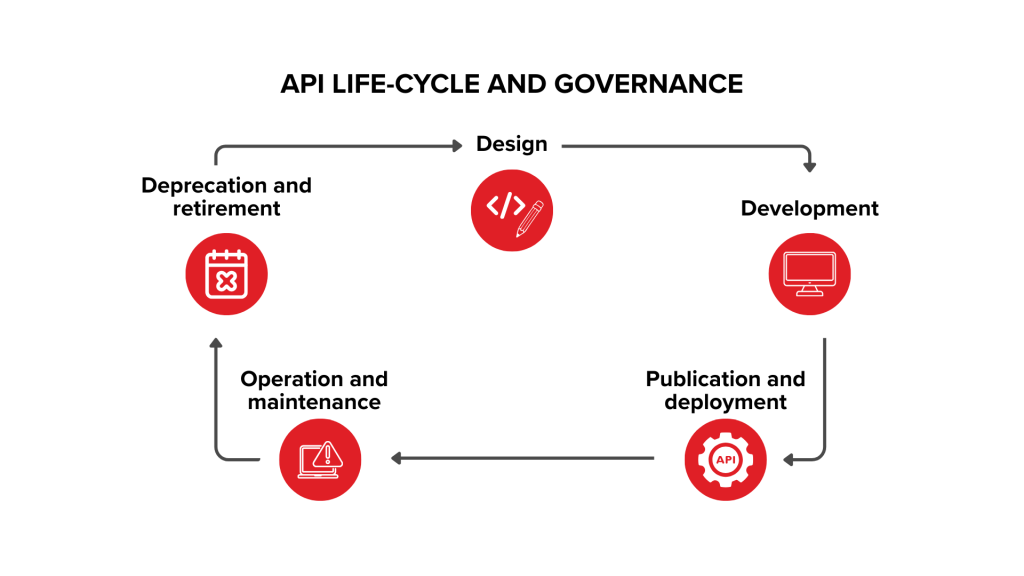
API Governance applied within the API lifecycle refers to the set of rules and controls that ensure the API cycle is consistent, secure, and maintainable. Governance as a “full-lifecycle” approach must accompany each stage of the lifecycle:
1. Design
The API is designed before it is programmed: what endpoints it will have, what data it will receive/return, how errors will be handled, pagination, etc. This is often called a design-first or “contract-first” approach.
Here, governance establishes:
- Mandatory use of OpenAPI Specification as the standard contract.
- Design rules: naming, resource structure, HTTP codes, versioning.
- Early review to avoid inconsistent or redundant APIs.
2. Development
At this point, the team implements the API (code), creates tests, integrates with databases/services, and prepares the artifact for deployment. In addition, automatic validations (linting/contract checks) are applied to verify that the implementation complies with the contract and rules:
- OpenAPI contract validation.
- Compliance with defined security standards.
- Compatibility and consistency tests.
The goal is to detect errors before reaching production, reducing rework and risks.
3. Publication and deployment
Upon publication, the API becomes available to consumers (internal or external): it is deployed in an environment (pre/prod), a URL is exposed, and its details are announced/registered.
Governance defines how and under what conditions an API is exposed: minimum documentation, versioning, and traffic/security policies applied at the entry point.
In this way, it is executed with an API Gateway (or equivalent technology), where controls such as rate limits or access are applied:
- It is not published if there is no OpenAPI spec.
- It is not published if there is no defined authentication.
- Rate limit mandatory for public APIs.
4. Operation and maintenance
This is the real life of the API in production: monitoring, incidents, performance adjustments, usage analysis, and controlled evolution.
Governance ensures that the API continues to comply with policies and that risk is managed: observability, abuse control, periodic reviews, and focus on typical API threats (data exposure, broken authentication, etc.).
A published API remains under governance:
- Monitoring of usage, errors, and latency.
- Security and compliance auditing.
- Controlled change management and communication to consumers.
Governance allows complete visibility into the state of the API ecosystem.
5. Deprecation and retirement
Many organizations fail at this stage. When an API (or version) should no longer be used, it is not simply “turned off”: it is deprecated (notice is given and it is maintained for a period of time) and then retired (deactivated).
Governance defines clear rules: how long notice is given, how it is communicated, and how versions coexist for migrations. One example is Google, which states in its versioning guidelines that different versions can coexist to allow for transitions and that there must be a reasonable and communicated period before shutdown; and in AIP-185, it recommends deprecation periods (e.g., 180 days for certain cases).
Some examples:
- Deprecation schedule (clear dates).
- Mandatory migration guide.
- Temporary parallel support for v1 and v2.
Properly managing retirement avoids broken dependencies and technical debt.

Key components and technologies in an API governance strategy
API governance does not only depend on documentation or regulations behind its operation, it also materializes through tools, standards, and architectural patterns that allow governance decisions to be defined, applied, and enforced in a consistent and automated manner.
In this section, we will look at what these components are, what problems they solve, and how they fit into a modern API governance strategy.
API Management Platforms
API Management platforms are the operational core of API governance. They provide a central point from which to apply common policies to all APIs, regardless of the team or technology that implements them.
Their role within governance is to:
- Centralize security, usage, and versioning policies.
- Publish and catalog APIs.
- Ensure consistency and traceability.
Some relevant examples:
- Gravitee: modern API management platform with a strong focus on API governance, security, and lifecycle control. Gravitee offers an open source core and enterprise capabilities for policy enforcement, versioning, access control, and developer portals.
- WSO2: This is a mostly open-source API management platform, with WSO2 API Manager as its main component. It allows for complete API governance: design, security, versioning, policies, and access control, with the option of commercial support and extensions.
- Kong: Kong is open source in its main component, Kong Gateway (Community Edition), which allows technical API governance policies such as authentication, rate limiting, and traffic control to be applied under an Apache 2.0 license. Advanced centralized management, analytics, auditing, and organizational governance capabilities are part of its commercial editions (Enterprise and Kong Konnect).
- Apigee: Apigee is a primarily commercial API management platform offered as a managed service by Google Cloud. It includes comprehensive API governance capabilities such as design, security, analytics, versioning, and access control from a centralized plane.
- MuleSoft (Anypoint Platform): This is a commercial platform geared toward enterprise-level API integration and governance.
It provides centralized design, security, versioning, policy, and reuse capabilities within a unified API ecosystem.
- Workato: Is an iPaaS (Integration Platform as a Service) platform with capabilities relevant to integration and API governance, especially in automation and business scenarios. Although Workato it is not a traditional API Manager it adds value in: Governance of integration flows, control and reuse of internal APIs, and security and access control in integrations.
The following article might interest you: Gravitee API Management: What is it and why does your company need it?
Architecture and infrastructure patterns
Architecture is where API governance becomes effective. It is not enough to define policies: they must be enforceable, controllable, and observable within the infrastructure. In modern environments (SOA and, above all, microservices), this is achieved by combining API gateways, service mesh, and security standards.
1. API Gateway: central point of enforcement
The API Gateway acts as the single point of entry to APIs. From an API governance perspective, it is the key component for consistently applying policies.
What it brings to API Governance:
- Centralized authentication and authorization.
- Rate limiting and consumption control.
- Routing and load balancing.
- Logging, metrics, and traceability.
- Uniform policy enforcement without touching the code.
The following article might interest you: Apache Apisix: The high-performance cloud-native API gateway for microservice architectures
2. Service Mesh: governance within the system
In microservice architectures, not all traffic passes through the API Gateway. Services also communicate with each other, and that’s where Service Mesh (such as Istio or Linkerd) comes in.
Role of Service Mesh in governance:
- Control service-to-service communication.
- Apply internal security (mTLS, authorization).
- Provide observability without modifying applications.
- Define resilience policies (retries, circuit breakers).
3. Authentication and authorization standards
API Governance also defines how APIs are accessed and under what rules. To do this, it relies on widely accepted standards:
- OAuth 2.0: standard for delegated authorization and access control.
- JWT (JSON Web Token): standard format for securely transmitting identity and claims.
Governance establishes common rules:
- Permitted OAuth flows.
- Scope and permission management.
- Token expiration and rotation policies.
This avoids ad hoc security solutions for each team.
SOA Architectures and Microservices
API governance is especially critical in microservices and even SOA architectures, where the number of APIs is growing rapidly.
Governance is essential for maintaining control and consistency in distributed microservices ecosystems.
In this context, a well-governed architecture:
- Reduces functional duplication.
- Facilitates API reuse.
- Allows teams to scale without losing control or security.
5. Specification and documentation
Specification and documentation are the foundation of API governance. Without a clear contract and consistent documentation, it is not possible to govern APIs in a scalable way. The specification is the source of truth, and the documentation is its representation for humans.
According to the OpenAPI Initiative, a standard specification allows APIs to be described in a way that is understandable to both people and tools.
OpenAPI Specification: the API contract
The OpenAPI Specification (OAS) is the most widely used standard for describing REST APIs. It defines in a structured way:
- Endpoints and operations.
- Parameters and request bodies.
- Responses and HTTP codes.
- Data schemas.
- Security mechanisms.
OpenAPI acts as a contract between producers and consumers, reducing misunderstandings and integration errors.
Design-first and governance
The design-first approach involves first defining the OpenAPI specification and then developing the implementation. This model facilitates governance because:
- It allows designs to be reviewed and approved before writing code.
- It makes standards visible from the outset.
- It facilitates automatic validation.
Automatic and consistent documentation
OpenAPI can be used to generate constantly updated documentation, avoiding the classic problem of obsolete documentation.
Common tools:
- Swagger UI: renders the specification in interactive format.
- Redocly: clear, consumer-oriented documentation.
- Developer portals: integrated into API Management platforms, such as Gravitee or WSO2.
Documentation as part of governance
From an API Governance perspective, documentation is not optional. Policies typically require:
- Documentation generated from OpenAPI.
- Minimum mandatory information (description, examples, errors).
- Clearly documented versions.
- Visible changes and deprecations.
Contract validation and quality
The OpenAPI specification also allows automatic quality controls to be applied, such as:
- Validation of breaking changes.
- Compliance with design guidelines.
- Security and naming rules.
Best practices for implementing API governance
Implementing API governance is not about imposing bureaucracy, but rather defining clear, automatable rules that enable APIs to be scaled with quality, security, and consistency. The most mature organizations apply API governance as an enabler, not a hindrance.
The following is a summary of key best practices, backed by recognized sources.
1. Define a clear API governance framework
The first step is to establish a governance framework that covers design, security, documentation, versioning, and operation.
This framework should answer questions such as:
- What standards are mandatory?
- Who approves designs and changes?
- What policies must be followed to publish an API?
2. Use OpenAPI as a mandatory standard
The OpenAPI Specification should be the base contract for all REST APIs.
Best practices:
- Mandatory specification prior to development.
- OpenAPI-based design review.
- Use of the specification as a source of truth.
3. Automate validations and controls
Governance should not rely solely on manual reviews. Leading organizations automate controls from design and CI/CD.
Examples of validations:
- Compliance with design guidelines.
- Detection of breaking changes.
- Minimum security rules.
4. Centralize policies without blocking teams
Good API governance combines centralized control with team autonomy.
How to achieve it:
- Global policies applied in API Gateway or Service Mesh.
- Freedom of internal implementation by team.
- Common standards, decentralized execution.
5. Treat security as part of governance
API security is not an add-on; it is a central part of API governance.
Best practices:
- Standard authentication (OAuth 2.0, JWT).
- Mandatory rate limiting.
- Periodic risk review.
6. Document all APIs consistently
Documentation is a pillar of governance:
- Automatically generated from OpenAPI.
- Updated by version.
- Accessible to consumers.
Consistent documentation is key to API adoption.
7. Monitor and control API sprawl
The uncontrolled growth of APIs is one of the main risks.
Best practices:
- Maintain a central inventory of APIs.
- Detect obsolete versions.
- Define clear deprecation policies.
8. Define clear roles and responsibilities
Governance requires ownership:
- Who is responsible for each API?
- Who reviews standards?
- Who manages changes and deprecations?

First steps in API Governance
Starting an API Governance strategy does not require a major immediate transformation. The most successful organizations begin with small, clear, and actionable steps that generate control without slowing down delivery. These are the recommended first steps, validated by industry best practices.
1. Create an API inventory
Before you can govern, you need visibility.
Start by identifying
- Which APIs exist?
- Which versions are active?
- Who owns each API?
- Status (active, obsolete, internal, public).
2. Define a mandatory minimum standard
Don’t try to govern everything from day one. Define a non-negotiable minimum:
- Mandatory OpenAPI specification.
- Standard authentication (OAuth 2.0 / JWT).
- Basic design and versioning rules.
- Minimum required documentation.
3. Choose the point of enforcement
Decide where policies apply:
- API Gateway for access control, traffic, and security.
- CI/CD for contract and design validations.
- Service Mesh (if applicable) for internal governance.
4. Automate from the design stage
Manual governance does not scale. From the outset:
- Validate OpenAPI automatically.
- Detect breaking changes.
- Apply basic security rules.
5. Define roles and ownership
Each API must have a clear owner.
Best practices:
- One API owner per API.
- A small governance team or role (not a cumbersome committee).
- Clear responsibilities for changes and deprecations.
6. Start small and evolve
Don’t try to implement a complete framework from day one.
Start with:
- New or critical APIs.
- Simple and measurable rules.
- Continuous feedback from teams.
The following article might interest you: 11 Steps to achieving a successful API Management Strategy
Frequently asked questions about API Governance (FAQ)
Below are answers to some of the most frequently asked questions about API Governance, designed for both technical teams and architecture and product managers.
What exactly is API Governance?
API Governance is the set of rules, standards, processes, and controls that ensure APIs are designed, published, protected, and maintained consistently and securely throughout their lifecycle.
How does API Governance differ from API Management?
- API Management focuses on the operation: publishing, protecting, monitoring, and analyzing APIs.
- API Governance defines which rules must be followed and how they are applied throughout the lifecycle.
Does API Governance slow down teams?
No, if implemented correctly.
When governance is automated and integrated into CI/CD, it reduces rework, errors, and manual reviews, accelerating delivery.
Is it mandatory to use OpenAPI to govern APIs?
It is not mandatory by definition, but OpenAPI is the de facto standard for REST APIs and the most widely used in API Governance strategies.
Can API Governance be done without an API Gateway?
It is possible, but very limited.
The API Gateway is the main technical enforcement point for security, traffic control, and access.
What size company needs API Governance?
Any organization with more than a few APIs needs it.
The more the number of APIs and teams grows, the more critical governance becomes.
Is API Governance only for microservices?
No.
It applies to SOA, monolithic services exposed as APIs, internal integrations, and public APIs. It is more visible in microservices, but not exclusive to them.
Who should be responsible for API governance?
Ideally, a small governance role or team that defines standards and facilitates their adoption, not a cumbersome committee.
How to get started with API governance without big tools?
You can start with:
- OpenAPI as a contract.
- Simple design guidelines.
- Basic validations in CI/CD.
- A simple API gateway or even documented rules.
As organizations scale their digital ecosystems—with microservices, integrations, and APIs exposed to third parties—API governance becomes critical to maintaining control, security, and speed.
The key is not to add more processes, but to design a governance framework aligned with each organization’s architecture and maturity.
At Chakray, we help organizations design, implement, and evolve API governance strategies tailored to their technical and business context.
We see API governance as an enabler, not a barrier. Our goal is to help you scale your APIs with confidence, security, and control, without losing agility.