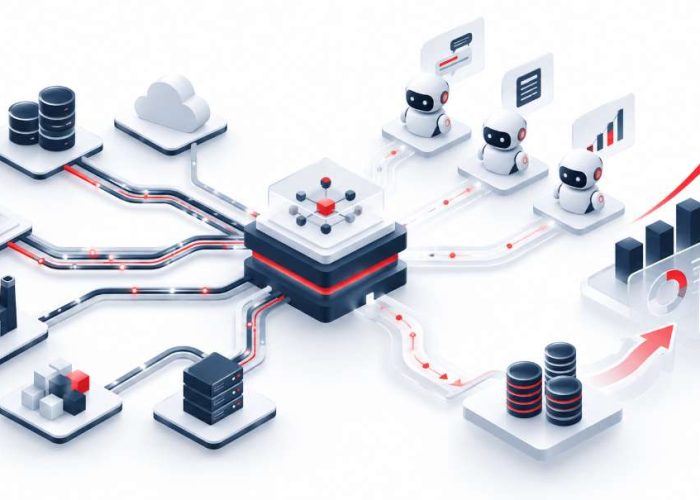
Continuous legacy modernization through microservices provides a structured framework for evolving technology infrastructures without treating modernization as a series of isolated initiatives. This incremental approach enables legacy systems and microservice-based architectures to coexist while supporting ongoing business evolution.
In this article, we explore best practices for implementing a secure and efficient continuous modernization architecture, review proven architectural patterns, and examine a real-world example of the challenge CTOs face when enabling the coexistence of legacy systems and distributed architectures.
Why is it such a challenge to modernise architectures without downtime?
Migrating services in a single, simultaneous operation—commonly known as a Big Bang migration—may appear to be an attractive strategy. However, beyond the inherent risks of this approach, organizations must also consider the likelihood of project failure if continuous governance is not established.
According to various industry sources, 70% of modernization projects fail, primarily due to the inability to implement effective operational governance. At the same time, technical debt accumulated within legacy systems becomes increasingly difficult to manage.
Technical debt typically resurfaces in the form of:
- Fragile integrations
- Inconsistent data flows
- Teams maintaining duplicate business logic in parallel
For this reason, successful modernization requires continuous synchronization across multiple architectural layers rather than being treated as a one-time migration event.
If you’d like to learn more about legacy modernization and its integration with modern architectures, we recommend reading: Modernizing legacy systems in hybrid cloud environments: best practices
Real-world example: Legacy–microservices disconnect
A financial retail company processed its payments using a monolithic ERP system that had been in operation for more than fifteen years. When the organization attempted to modernize its e-commerce platform using microservices, communication between the legacy platform and the new services relied on overnight batch updates and point-to-point integrations rather than real-time synchronization.
The outcome included:
- Duplicate transactions during peak sales periods.
- Inventory balance discrepancies.
- A complete lack of end-to-end traceability across both environments.
Rather than replacing the ERP, the organization focused on governing how systems communicated by introducing clear integration rules.
To achieve this, the company:
- Implemented Apache Kafka as a centralized event backbone for real-time data exchange.
- Created versioned OpenAPI contracts so every application could exchange information through clearly defined interfaces.
- Introduced a reconciliation mechanism to periodically verify financial consistency.
As a result, the payment platform experienced zero downtime during the production rollout.
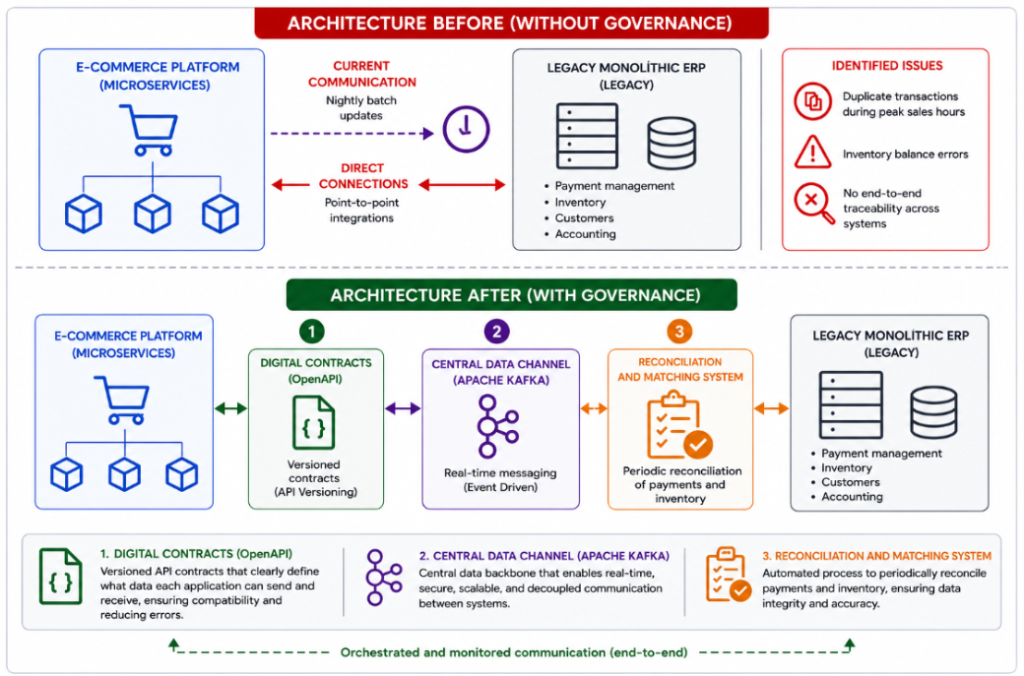
Enterprise architecture before and after modernization
What are the proven patterns for integrating legacy and microservices?
Building a resilient architecture for continuous legacy modernization requires several well-established integration patterns. Among the most important are:
- Strangler Fig: This pattern intercepts traffic destined for the legacy system through a façade, gradually replacing monolithic functionality with microservices until the legacy application can eventually be retired.
- API Gateway / Backend for Frontend (BFF): Serves as a single entry point for routing and abstraction, decoupling client applications from the underlying implementation.
- Event-Driven Architecture (EDA): Eliminates synchronous coupling by using a messaging backbone—such as Apache Kafka—that allows the legacy system to publish events (for example, “Order Created”) which microservices consume asynchronously, enabling loose coupling without interrupting existing business processes.
An Anti-Corruption Layer (ACL) completes this architecture by acting as a translation layer that protects modern microservices from the inconsistencies and proprietary formats of the legacy system. Without this layer, design flaws and data inconsistencies from the legacy platform inevitably propagate into new applications.
Within this architecture:
- OpenAPI/Swagger ensures API contracts remain explicit and well-defined.
- Apache Kafka guarantees durable event storage and replay capabilities in case of failures.
- RabbitMQ provides advanced message routing and supports dead-letter queues for lower-volume messaging workloads.
Finally, for development teams to operate independently, these architectural rules should be enforced in the implementation itself rather than existing only as documentation.
Strangler fig: incremental migration through a façade
The Strangler Fig pattern introduces a central façade—typically implemented through an API Gateway—that receives all incoming user traffic and progressively redirects requests to newly developed microservices while keeping the legacy platform available as a fallback.
If a newly deployed service encounters an issue, the façade immediately redirects traffic back to the legacy application without requiring manual intervention.
The duration of each migration phase depends on factors such as:
- Business domain criticality
- Coupling with other systems
- Regulatory requirements
- Test coverage
- Integration complexity
In real-world projects, it is generally advisable to begin with domains that have minimal dependency on the transactional core, such as:
- Query services
- Product catalogs
- Reporting
- Selected user management services
This allows organizations to validate the architecture, deployment process, and operational model before migrating highly critical components such as payment or financial processing services.
API-first and contract governance in hybrid environments
An API contract is a digital agreement between the provider of a web service and its consumers. It defines the rules governing which information can be requested and how responses are returned.
How Are Changes Managed?
To prevent updates from breaking dependent systems, three complementary practices are commonly adopted.
Semantic Versioning
A three-part version number communicates the scope of every change:
- Major: Introduces breaking changes that are not backward compatible.
- Minor: Adds new functionality while maintaining backward compatibility.
- Patch: Includes internal fixes without affecting existing functionality.
Deprecation Notices
When an API version is scheduled for retirement, consumers are notified in advance to allow sufficient time for migration. Although there is no mandatory minimum notice period, organizations typically provide several months before removing support.
Automated Contract Testing
Before releasing a new API version, tools such as Pact, Spring Cloud Contract, and Dredd automatically verify that implementation changes remain compatible with the published contract.
The Human Factor: Governance
Technology alone is not enough.
Organizations commonly use RACI matrices to define clearly:
- Which team owns each API contract.
- Which stakeholders must be informed about upcoming changes.
- Who has final approval authority over breaking changes.
If you want to learn how to design APIs from the contract-first perspective to improve performance, security, and scalability, we recommend reading: API First: what it is, benefits, and how to implement it with security, governance, and scalability
How can you achieve data synchronisation and distributed consistency without disrupting the business?
When organizations combine legacy systems with microservices, data synchronization issues are almost inevitable. If one system updates information while another remains unaware of the change, business operations can quickly be affected.
How can data be synchronised without breaking existing systems?
Two proven architectural patterns are commonly used to exchange information safely between legacy and modern applications.
- Transactional Outbox Pattern
Rather than attempting to update two independent systems simultaneously—a strategy that is both fragile and prone to failure—the application records the business transaction in its primary database while, within the same transaction, writing a pending event to an outbox table.
A separate background process continuously monitors this outbox, retrieves pending events, and publishes them to a messaging platform such as Apache Kafka or RabbitMQ, allowing downstream systems to process them asynchronously.
- Change Data Capture (CDC)
When a legacy system is too old or complex to modify directly, Change Data Capture (CDC) provides a non-invasive alternative.
Technologies such as Debezium monitor the legacy database for changes. Whenever new or updated data is detected, the change is automatically captured and published as an event to the modern architecture without requiring modifications to the legacy application’s source code.
Transactional Outbox and Idempotency: Reliability Without Locking
The Transactional Outbox pattern follows a strict sequence that guarantees information is not lost.
- The legacy application processes the business transaction.
For example, it records a successful customer payment in its primary database. - An event is recorded simultaneously.
Within the same transaction, the application writes an event such as “Order Paid” into the outbox table. - The event is published.
A background service continuously scans the outbox, retrieves pending events, and publishes them to a messaging platform such as Apache Kafka. - Modern services react asynchronously.
Microservices subscribed to that event automatically process the notification. For example, the inventory service receives the message and updates stock levels accordingly.
Protection Against Duplicate Messages
Network failures can occasionally result in duplicate message delivery.
To prevent duplicate processing, systems implement idempotency, typically through two complementary mechanisms:
- Unique Event IDs: Every event includes a unique identifier, similar to a parcel tracking number.
- Idempotency Filtering: Consumer services maintain a record of previously processed event IDs. If the same event is received again, it is safely ignored instead of executing the business operation twice.
Distributed observability: how can you track transactions in real time?
When a business process spans multiple legacy and modern systems, traditional all-or-nothing transactions are no longer practical.
Imagine the following scenario:
- System A successfully charges a customer’s credit card.
- System B fails while reserving the hotel.
Without an appropriate coordination mechanism, the customer loses both the reservation and the payment.
The solution is the Saga Pattern.
The Saga Pattern: a chain of independent transactions
Rather than locking every participating system, each service completes its own transaction independently before notifying the next participant.
If a failure occurs midway through the process, compensating transactions are triggered to reverse previously completed operations—for example, issuing a refund.
There are two primary approaches to coordinating a Saga.
- Orchestration: A central coordinator acts as the conductor, instructing every service what to do and when to do it. For example:
- Service A processes the payment.
- Service B reserves the hotel.
If any step fails, the orchestrator instructs all affected services to execute their corresponding compensation actions.
- Choreography: In a choreography-based Saga, there is no central coordinator.
Each service completes its own work and publishes an event upon completion. Other services subscribe to these events and determine independently whether to continue processing. If an error occurs, the affected service publishes a failure event, enabling the remaining services to execute their compensation logic autonomously.
Decision playbook: when and how should each Legacy module be decoupled?
Prioritizing which legacy module should be modernized first should never be based solely on technical preferences.
Instead, production telemetry provides objective decision-making criteria, including:
- Transaction volume
- Failure rate
- Average latency
These operational metrics provide measurable evidence for building an effective modernization roadmap and determining which business domains should be migrated first.
The following table provides an example framework for prioritizing legacy modules based on business impact, technical complexity, and regulatory considerations.
| Module | Business Impact | Technical Complexity | Applicable SLA / Regulation | Recommended Action (Example) |
| Product Catalog | High | Low | No direct regulatory restrictions | Phase 1: Migrate first (Quick Win). Useful as a pilot to validate the infrastructure with low regulatory risk. |
| User Management | Medium | Medium | Subject to the General Data Protection Regulation (GDPR) and, in Spain, Organic Law 3/2018 on Personal Data Protection and Guarantee of Digital Rights (LOPDGDD) (subject to confirmation depending on the type of personal data processed). | Phase 2: Second wave. Requires a gradual migration using techniques such as the Strangler Fig pattern to mitigate privacy risks. |
| Financial Reporting | Medium | Low | Data retention periods (vary by jurisdiction; for example, Spain’s General Tax Law requires four years, while the Commercial Code requires six years). | Phase 3: Third wave. Parallel migration with the product catalog is not recommended. Requires isolated audit environments to ensure data integrity. |
| Payment Engine | Critical | High | Internal business requirements / Industry regulations (e.g., PCI DSS security standard). | Phase 4: Final stage. Scheduled for the end due to its high operational criticality. Requires extensive load testing and controlled deployments. |
Operational governance and organizational change during hybrid coexistence
Keeping legacy systems and microservices synchronized requires more than technology. It also demands clear governance that defines responsibilities across teams.
A common approach is to establish a RACI matrix that documents:
- Which team is responsible for designing and maintaining API contracts.
- Which departments—such as Security or Legal—must approve changes that could introduce breaking compatibility.
- Who is responsible for ensuring service-level objectives (SLOs) are consistently met.
Each organization should assign these responsibilities according to its own governance model and internal policies.
Cross-team coordination and fit-for-purpose tooling
When engineering teams are organized around business domains, they require formal processes for updating or retiring existing functionality. This prevents one team’s changes from unintentionally disrupting another team’s services due to a lack of coordination.
The same principle applies to messaging platforms.
There is no universal requirement to standardize on a single messaging technology. Organizations may choose to adopt one platform across the enterprise or combine multiple solutions—such as Apache Kafka and RabbitMQ—depending on the requirements of each workload.
Continuous training on advanced integration patterns—particularly the Saga Pattern for long-running distributed transactions—also helps ensure engineering teams design and implement systems according to consistent architectural principles.
Where can you learn more?
If you would like to see how these concepts are implemented in real-world enterprise environments, the following technologies provide valuable reference material:
- WSO2 API Manager and Gravitee — Comprehensive platforms for learning API lifecycle management, governance, and versioning.
- Apache Camel — A leading integration framework for connecting heterogeneous enterprise systems.
- Keycloak — A widely adopted identity and access management platform for securing distributed applications.
At Chakray Consulting, we help organizations design and implement future-ready hybrid architectures.
Our expertise spans API Management, enterprise integration, event-driven architectures, legacy modernization, microservices, and technologies including WSO2, Gravitee, Apache Camel, and Apache Kafka. This enables us to deliver progressive modernization strategies tailored to each organization’s business and technical objectives.
If you’re evaluating how to evolve your technology ecosystem without replacing your existing infrastructure, contact our team to discover how we can help you build a more scalable, resilient, and future-ready architecture.
FAQ
How do I know whether my legacy system is ready to coexist with microservices?
Validate four criteria with justified thresholds: test coverage ≥60% (to avoid post-migration surprises), versioned API documentation in OpenAPI 3.0+, the ability to expose data through events using CDC or instrumented Outbox, and a messaging infrastructure with lag monitoring and active dead-letter queues. If any of these elements are missing, begin with incremental legacy refactoring before decoupling.
What is the safest pattern to start without the risk of downtime?
Strangler Fig combined with an API Gateway: traffic is redirected incrementally toward microservices while maintaining automatic fallback to the legacy system if the new service fails. Begin with non-critical workloads—such as reporting and search—before moving on to payment or financial systems.
Do I need to rewrite the entire legacy system to modernize it?
No. Wrap the legacy system with an Anti-Corruption Layer and versioned APIs. Modernize only those modules that generate the greatest measurable value: revenue, scalability, and delivery speed. Use technical debt as a prioritization metric, not as a justification for a complete rewrite.
Kafka or RabbitMQ: which one should I choose?
Kafka for streaming, event replay, and long-term retention. RabbitMQ for complex routing, dead-letter queues, and lower operational overhead. The deciding factor is the team’s existing expertise: start with the technology your engineers already master and scale from there.
How do I monitor synchronization between legacy systems and microservices in production?
Use distributed tracing with end-to-end propagated Correlation IDs, define SLIs for critical business flows (latency, error rate, and data completeness), and configure alerts for SLO deviations. Include periodic data reconciliation: daily for financial systems and hourly for inventory.
How long does it take to migrate a legacy domain to microservices?
Between 3 and 12 months per domain, depending on its criticality: reporting and search (3–4 months), user management (5–7 months), and financial services (9–12 months). The limiting factor is the clarity of domain boundaries and the existing level of test coverage—not development speed.
Contact our team and discover the cutting-edge technologies that will empower your business.

Talk to our experts!