Does your company have scattered APIs, data, and connections that consume hours of work just to organize them and leverage their true potential?
This scenario is more common than it seems in medium and large companies. It is known as API Sprawl, a phenomenon that complicates the governance, security, and scalability of digital ecosystems.
The most effective solution lies in Artificial Intelligence itself. This tool is transforming the way we design, protect, and optimize APIs.
In this article, we explore how AI powers API management platforms, what their main use cases are, and what benefits (and challenges) their implementation in modern business environments entails.
What is AI-Driven API Management?
AI-Driven API Management is an approach to API management that incorporates machine learning, deep learning, and intelligent analytics to automate, optimize, and secure the entire API lifecycle.
In many modern enterprises, the rapid growth and expansion of applications and services is not keeping pace with their management and control. As a result, many APIs remain undocumented, leading to security issues, governance problems, and wasted resources.
APIs are often created in a hurry, and over time, no one maintains adequate control over them, so they are forgotten as teams move on.
In this context, AI allows for the incorporation of API discovery tools that analyze network traffic, code repositories, and other sources in order to identify these APIs by recognizing patterns and data types.
There are many operational benefits enabled by artificial intelligence. The main value lies in the automation of tasks and the reinforcement of best practices in API governance, which allows for greater security in protocols and corrects malpractice that can drag on for years in their documentation and maintenance.
How API Management incorporates artificial intelligence
API management has evolved into an intelligent system that learns and adapts through AI, moving beyond being just a set of control tools and policies.
As a result, API management platforms powered by this technology are now capable of doing much more: they anticipate problems, optimize traffic flows, and protect infrastructures with unprecedented precision and efficiency.
The Evolution of API Management with AI
API management began as a discipline focused on security, governance, and traffic control. With traditional platforms, it was a matter of applying static rules to allow or deny access, monitor usage, and generate basic metrics.
With the rise of artificial intelligence and machine learning, these tasks have given way to capabilities such as:
- Intelligent automation: AI enables automation of much of the API lifecycle, from documentation to detection of operational issues, without human intervention.
- Predictive analytics: Systems can predict traffic spikes, identify bottlenecks, and anticipate failures, enabling proactive action.
- Anomaly detection: With machine learning, the platform can understand usage patterns and detect unusual behavior that indicates failures or attacks.
The transition to AI-driven APIs is so profound that Gartner projected that, by 2026, more than 80% of enterprise APIs will use generative or adaptive AI, with capabilities that go beyond that, toward interfaces that learn and evolve in real time.

AI-Driven API management architecture
Difference between traditional and AI-driven API management
La diferencia principal entre la gestión tradicional de APIs y el enfoque AI-Driven radica en cómo se toman las decisiones y se aplican las políticas:
The main difference between traditional API management and the AI-driven approach lies in how decisions are made and policies are enforced:
| Aspecto | Traditional API Management | AI-Driven API Management |
| Rules model | Static rules configured manually without dynamic context. | Adaptive policies that automatically adjust based on patterns detected by AI. |
| Operational approach | Reactive: acting after an incident has occurred. | Predictive and preventive: anticipates problems before they impact production. |
| Analytics | Retrospective: based on historical data without automated decision-making. | Real-time analytics with continuous learning that feeds automatic decisions. |
| Security | Based on signatures, predefined rules, and checklists. | Anomaly detection with machine learning and behavioral analysis. |
| Human intervention | High dependence on technical equipment for adjustments and improvements. | Advanced automation that reduces manual intervention. |
| Cloud Scalability | Scheduled or manual scaling. | Predictive scalability based on usage patterns. |
| Traffic management | Manually configured limits and balancing. | Dynamic optimization and intelligent auto-scaling based on usage patterns. |
| Governance | Manual review of compliance and documentation. | Automated governance with generative AI and intelligent validation. |
| Developer experience | Static documentation and manual support. | Intelligent assistants, automatic document generation, and optimized SDKs. |
| Cloud scalability | Scheduled or manual scaling. | Predictive scalability based on data and actual consumption. |
| AI API Management | Not ready for generative models or agents. | Designed to manage LLMs, autonomous agents, and generative AI services. |
| Cost optimization | Difficult to predict consumption and peaks in demand. | Intelligent consumption control (tokens, requests, cloud resources). |
In summary, traditional API management is based on applying what the team decides manually, while AI-Driven API Management learns from actual usage, anticipates changes, automates decisions, and adapts to deliver higher performance, availability, and security.
You may be interested in the following article: API Governance: What it is and how to implement effective API governance step by step

Stack AI-Driven API Management (layers)
AI-driven API management is not just a technology; it is a multi-layered stack that brings together cloud infrastructure, gateways, machine learning models, security standards, and developer tools.
Below, we break down the main layers that make up this ecosystem.
1. Infrastructure layer (Cloud Computing)
Every AI-powered API management strategy relies on cloud computing environments, which enable:
- Automatic scalability
- High availability
- Multi-region deployment
- Advanced observability
This layer includes:
- Kubernetes / containers
- API Gateways
- Load balancers
- Monitoring systems
2️. Gateway and control layer (API Management Core)
This is where the traditional management engine is located, but enhanced with AI:
- Intelligent routing
- Traffic control
- Dynamic rate limiting
- Versioning and lifecycle management
Platforms such as WSO2 or Gravitee API Management already integrate advanced analytical capabilities to optimize API usage.
At this level, management begins to incorporate intelligent API management capabilities, allowing policies to be adjusted according to actual behavior.
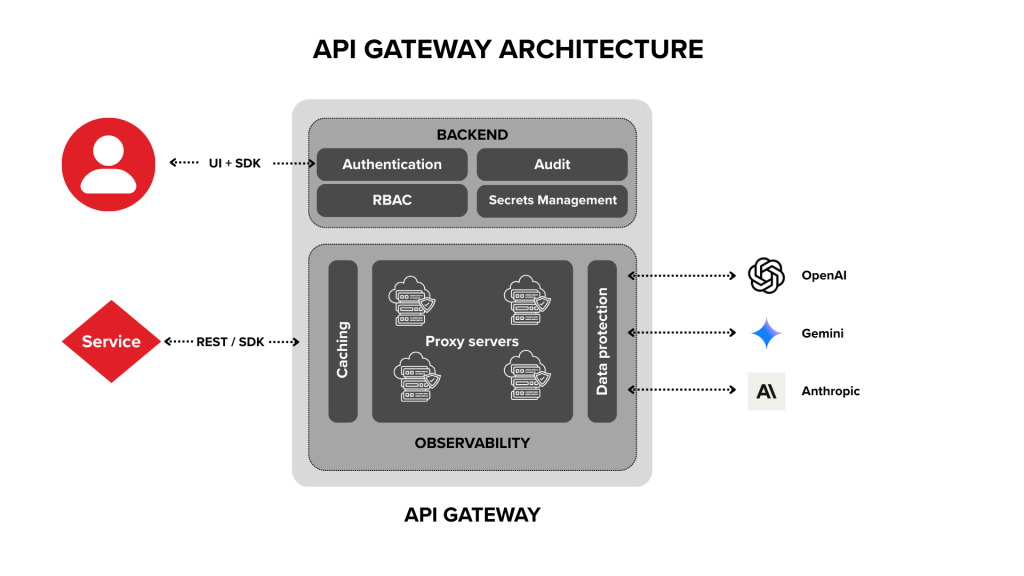
API Gateway Architecture
3️. Artificial Intelligence Layer (Machine Learning & Deep Learning)
This is the layer that makes the system truly AI-driven.
Includes models of:
- Machine Learning for anomaly detection
- Deep Learning for complex behavior analysis
- Natural Language Processing (NLP) for automatic documentation and semantic analysis
- Computer Vision when APIs manage image or video processing
This layer also integrates APIs from providers such as OpenAI, Google Cloud APIs, and Claude API, which expose generative models via REST APIs, allowing text, image, or audio capabilities to be added to enterprise platforms.
4. Security and authentication layer
AI enhances API security through machine learning for real-time threat detection.
A modern AI-driven API management stack should incorporate:
- Smart Authentication: Use of OAuth2, JWT (JSON Web Tokens), and API keys, validated through behavioral analysis to ensure that the user not only has the correct credentials but is also acting legitimately.
- Dynamic Role Management: Permissions and access are instantly adapted according to the context of the session, applying the principle of least privilege.
- Agent Identity Verification: Machine-to-machine authentication for AI agents calling other agents, ensuring traceability in complex flows.
- Prompt Injection Mitigation: Defense against attacks that attempt to manipulate language models (LLMs) through user prompts.
- Model Inversion Protection: Prevents attackers from reconstructing confidential training data by analyzing API outputs.
5️. Observability layer and predictive analytics
This layer enables the system to continuously learn:
- Real-time metrics
- Traffic analysis
- Peak consumption prediction
- Bottleneck identification
6️. Developer Experience (DX) Layer and SDKs
A modern stack is not complete without tools that facilitate adoption:
- SDKs (Software Development Kits)
- Developer portals
- Automatic documentation generation (OpenAPI + AI)
- Automated testing
The combination of AI-driven API design + SDKs accelerates integration and reduces human error.
The following article may be of interest to you: AI Gateway: Smart management between applications, models, and AI APIs
Use cases for AI in API management
Below, we outline some of the most relevant use cases for AI in API management, using the data shown by API 7 as a reference.
1. Automated API design and testing
AI tools analyze existing documentation and usage patterns to suggest improvements, generate code snippets, and produce comprehensive documentation, accelerating development and reducing errors before reaching production. This is not theoretical: AI-powered API portals already incorporate intelligent recommendations and code suggestions for developers.
Example in action:
- An organization implementing API7 Enterprise sees all endpoints automatically documented with AI-generated suggestions.
- Design recommendations reduce common errors and automate test case creation, which decreases production failures and accelerates the development cycle.
The following article may be of interest to you: QA Automation in your APIs with artificial intelligence
2. Predictive analytics and production performance optimization
AI algorithms are also used to analyze usage trends and predict performance issues, for example, by identifying which endpoints have higher traffic or latency before they impact end users.
Case in action:
- A high-traffic platform uses predictive analytics built into the API gateway, dynamically adjusting backend resources based on the model’s predictions.
- This improves responsiveness and reduces latency just before traffic spikes without human intervention.
3. Real-time threat detection and automated security
AI-powered API management enables the detection of anomalous behavior patterns that indicate threats or API abuse before they become security incidents.
In environments where APIs handle sensitive data, AI can continuously analyze requests and automatically block malicious traffic or unusual patterns, helping to prevent attacks without the need for manual rule definitions.
4. Improving developer experience (DX) with intelligent assistance
AI-powered API management tools are already offering features that answer developers’ questions, guide API usage, and solve problems in real time.
Real action in development teams:
- Developers receive intelligent suggestions in their IDEs or API portals, reducing the learning curve and accelerating the adoption of new APIs.
- This translates into shorter development times and fewer human errors in API integration.
Recommended providers WSO2 API Manager
WSO2 offers a comprehensive API lifecycle management platform that now incorporates advanced AI capabilities for API governance, security, and optimization, including AI service APIs and modern generative models. Its model combines both open source software (WSO2 API Manager) and a native AI SaaS offering (Bijira).
- AI-driven governance: The platform interprets documentation, rules, and specifications using generative AI to ensure that APIs automatically comply with internal policies and industry standards, reducing errors and manual effort.
- AI-powered design assistant: Tools such as WSO2 MI Copilot facilitate the creation and refinement of APIs using natural language, making it accessible even without deep technical knowledge.
- Centralized control and flexible management: Unified control plane for complete visibility into the API lifecycle, policies, security, and governance in hybrid or multigateway environments.
Risks and challenges of AI APIs
When we talk about APIs that expose AI systems or integrate artificial intelligence capabilities, their use involves technical and security challenges that go beyond those of traditional APIs.
1. Model manipulation and adversarial input
Attackers can design malicious data inputs that trick AI models into producing unwanted or dangerous results. This includes data poisoning and adversarial attacks that change the model’s behavior without the API detecting traditional anomalies.
2. Exposure and abuse of attacker’s API control
If an attacker manages to control or abuse the APIs that connect to AI systems, they can:
- Trigger unauthorized operations,
- Extract sensitive data,
- Manipulate AI decision-making logic.
AI systems are only as secure as their APIs, as these act as gateways to critical models, data, and processes.
3. Insufficient authentication and authorization
AI APIs often require integration with external services and on-demand resource consumption (e.g., generative models), which exposes additional attack vectors if authentication is not robust.
A common mistake is to rely on basic access methods without advanced controls such as OAuth 2.0 with fine-grained scopes or context-based access policies.
4. Sensitive data filtering and exfiltration
AI APIs consume and generate information (including text, images, or voice signals) that may contain personal data or confidential strategies. If not properly protected, this information can be leaked using simple collection techniques or automated scraping.
5. Overdependence and automation of large-scale attacks
The same mechanisms that make AI powerful can also automate cyberattacks, including:
- Rapid scaling of malicious attempts.
- Generation of harmful inputs by AI.
- Exploitation of APIs to compromise other connected systems.
If an attacker controls the flow of inputs to an AI model, they can automate attacks on a massive scale via APIs before traditional defenses can respond.
The following article may be of interest to you: Keys to Improve API Data Encryption

The future of AI integration in APIs
Are we prepared for the impact that artificial intelligence will have on the evolution of APIs?
The future of artificial intelligence integration in APIs is being defined by major advances. By 2026, these advances will transform not only how services are consumed, but also how APIs themselves evolve to become intelligent and autonomous.
1. APIs designed for interaction with AI and autonomous agents
APIs are no longer simple interfaces for human applications; they are now native interfaces for AI agents and autonomous models. This means that APIs:
- They are exposed as Model Context Protocol (MCP) servers that describe actions, access, and expected usage for AI models.
- They become the first citizens of the agent ecosystem, facilitating discovery, use, and governance by intelligent tools.
- They eliminate the need for AI to “scrape” documentation by offering structured, machine-readable contracts.
2. Integration of AI as an operational engine, not just a functional one
One of the strongest predictions for 2026 is that AI will evolve from an assistance tool to become the central engine of IT operations. In this context:
- Companies will use AI models to detect anomalies, prioritize events, respond to incidents, and automate routine tasks within API platforms.
- Native integration with APIs will enable intelligent models to not only consume data, but also orchestrate, update, and validate tasks in real time, improving reliability and response speed.
3. Standardization, governance, and productive AI production at scale
For APIs to compete and collaborate in modern business environments, standards and governance will become strategic pillars this year. This includes:
- Wider adoption of protocols such as MCP to describe AI-oriented API capabilities.
- Deep integration of APIs with trained models and business context systems for secure and reliable operations.
- Maturation of API management practices as a strategic asset (not just a technical requirement) to accelerate ROI, measure business value, and ensure regulatory compliance.
FAQs
What exactly is AI-Driven API Management?
It is the evolution of traditional API Management that incorporates Machine Learning, predictive analytics, and intelligent automation to optimize the API lifecycle.
Instead of applying static rules, the system learns from traffic, detects anomalies, and automatically adjusts policies.
How does it differ from a traditional API platform?
The main difference lies in its ability to:
- Anticipate problems before they occur
- Optimize traffic in real time
- Detect threats through behavioral analysis
- Automate governance and documentation
While traditional management is reactive, AI-driven management is predictive and adaptive.
Is it necessary to use generative models such as OpenAI to implement AI-driven API management?
Not necessarily.
AI-driven management can be applied even without consuming external generative models. However, when generative AI APIs (such as OpenAI) are integrated, the need for:
- Consumption control (tokens, requests)
- Advanced security
- Observability
- Governance
What are the main risks of integrating AI into APIs?
Among the most relevant:
- Input manipulation (adversarial attacks)
- API exposure or abuse
- Sensitive data leakage
- Large-scale attack automation
- Unpredictable costs due to uncontrolled consumption
What types of companies should adopt AI-driven API management?
- Companies with microservices architectures
- Organizations that consume or expose generative AI APIs
- Multicloud or hybrid platforms
- Regulated industries that require strict governance
Does AI replace API Management teams?
No.
AI empowers teams, automates repetitive tasks, and improves decision-making, but it is still necessary to:
- Define policies
- Monitor models
- Ensure regulatory compliance
- Assess strategic risks
How to start implementing AI-Driven API Management?
- Evaluate your current API Management platform
- Integrate advanced analytics and real-time monitoring
- Implement robust authentication (OAuth 2.0)
- Test automation in documentation and testing
- Incorporate intelligent consumption control if you use generative AI APIs
At Chakray, we help organizations design and implement intelligent, secure, AI-ready API Management architectures.
We work with leading platforms and enterprise cloud solutions, integrating:
- Automated governance
- Multi-cloud strategies
- Performance optimization and advanced observability
If your organization is exploring how to integrate AI into its API ecosystem, we can help you define a clear, technical roadmap aligned with business outcomes. Contact us today.