Semantic governance is the formal and automated control of the shared meaning of data across an organization’s systems. Unlike traditional data management, and designed specifically to overcome data integration and interoperability challenges, this discipline relies on ontologies and structured metadata (such as executable contracts) to ensure that multiple heterogeneous platforms (legacy systems, cloud applications) and Artificial Intelligence models interpret the exact same information with the exact same business meaning.
In today’s corporate ecosystem, the leap toward productive artificial intelligence is frequently held back by a lack of reliable data context. Gartner warns that a lack of AI-ready data will lead to the abandonment of 60% of general AI projects through 2026. Meanwhile, a study by MIT Project NANDA points out that 95% of generative AI implementations fail to achieve measurable ROI, largely due to governance failures. This article details how semantic data contracts resolve this structural gap.
The challenge of data fragmentation in AI
The main issue in modern enterprise architectures is not the sheer volume of data, but the ambiguity with which it is integrated. When systems operating on different logics feed data without semantic rules into a training pipeline, AI models learn inconsistencies.
The cost of the semantic gap: a real-world insurance case
A health insurance company set out to train a generative AI model using historical policy records. The project ingested data from three sources: a legacy AS400 system, a cloud CRM, and an analytical data warehouse, but lacked explicit semantic contracts.
As a result, the model received the primary_diagnosis field encoded in ICD-9 from the legacy system, as free-text format from the CRM, and in ICD-10 from the data warehouse. Processing incompatible representations of the same clinical concept caused the AI to hallucinate, emitting incorrect predictions in 34% of comorbidity diagnoses. The project was stalled for six months, and operational costs multiplied by 1.5x.
Foundations of semantic governance
While classical governance inventories assets, traces technical lineage, and defines access roles, it cannot guarantee that a SAP system and a CRM deliver a given field with the exact same meaning. As industry publications specialized in data management like Anjana Data highlight, semantic governance addresses this by formalizing context in an executable manner before bad data contaminates the model.
Its core pillars are international standards backed by initiatives like the W3C:
- RDF: to represent graph relationships.
- OWL: to formalize enterprise ontologies.
- JSON-LD: to inject semantic context directly into REST API responses using the @context attribute within the JSON payload, linking simple fields to the formal ontology automatically.
Anatomy of a data contract
A data contract is not static documentation; as academic and industry publications such as EA Journals analyze, it is verifiable code between the data producer and the consumer (in this case, an AI model). A robust contract includes:
- Technical schema: data types, formats, and cardinalities.
- Semantic context: reference ontologies (e.g., schema:Person/age) that prevent misinterpretations.
- Quality rules: minimum thresholds, such as completeness or tolerance ranges.
- SLA (Service Level Agreement): maximum allowed latency and update frequency.
Semantic integration architecture
The semantic layer acts as a central mediator and as an enabler for modern decentralized architectures like Data Mesh. Leveraging integration architecture solutions from Chakray, organizations can ensure that legacy systems and AI agents share common meaning without altering original sources, allowing each business domain to manage its data autonomously without breaking global interoperability.
Following the principle of “write once, reuse everywhere”—popularized by industry references such as IBM Think and Databricks—definitions are maintained in the central layer and exposed via typed GraphQL queries or streaming events via Apache Kafka. However, if two organizational sources maintain conflicting, irreversible definitions, a governance committee must step in to arbitrate and establish the canonical version.
Evolving version control
The greatest operational risk occurs when a source API changes its structure and silently corrupts the AI model’s data pipeline.
The solution is to treat contracts as versioned code using semantic versioning (MAJOR.MINOR.PATCH) within a Schema Registry. It is critical to understand that backward compatibility is not automatic; it requires explicit policies configured in the registry. These policies act as a semantic Circuit Breaker: if a severe structural change is detected, they immediately halt data ingestion into the model. Without these active rules, an unvalidated change will flow into the system and degrade AI reliability.
Step-by-step implementation: designing an AI-Native integration architecture
To deploy this architecture in regulated ecosystems, the following workflow is recommended:
- Map silos and Define Ownership: inventory producer systems (core banking, CRMs) and consumer systems (AI, dashboards), establishing owners and current formats.
- Formalize and validate (OWL + SHACL): these standards are sequential, not alternatives. First, define the vocabulary and business logic rules using OWL (e.g., “the customer must be of legal age”). Next, apply the W3C specification for SHACL (Shapes Constraint Language) as a runtime barrier to validate incoming real-time data against those rules.
- Specify contracts: generate JSON-LD contracts containing quality rules and context, stored in a Git repository or Schema Registry.
- Deploy the exposure layer: enable consumption via GraphQL or Kafka.
- Audit lineage: log which model consumed which data, under what contract version, and from what origin, ensuring mandatory traceability for AI systems.
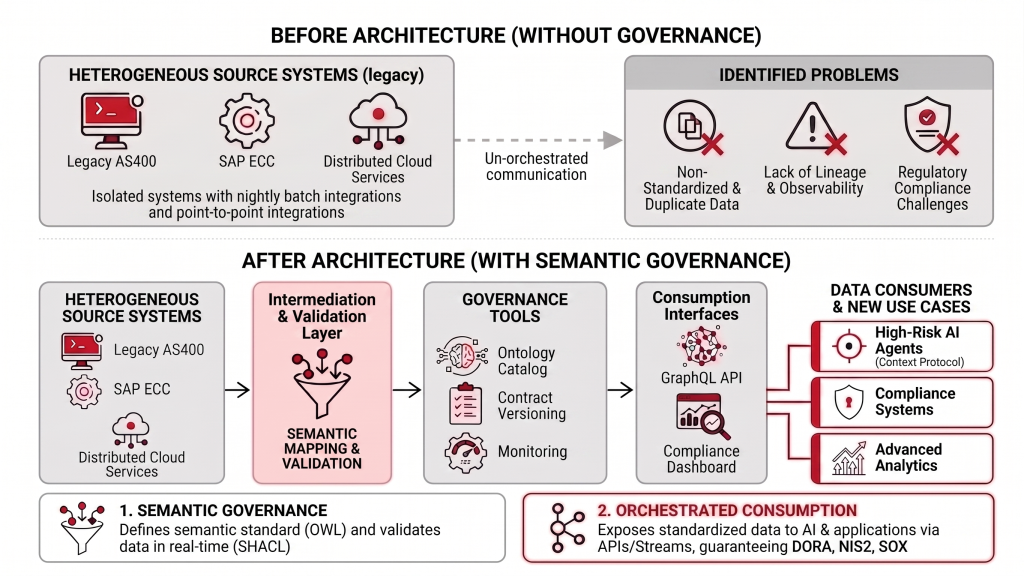
Architecture diagram of semantic governance for AI
Technical stack and regulatory compliance
The impact of the EU Data Act and the AI Act
Regulatory compliance in Europe has become the single biggest accelerator for semantic governance. The European Commission’s EU Data Act (in force since 2024 and mandatory from September 2025) requires systems to guarantee machine-readable formats and true semantic interoperability for data portability.
Furthermore, the EU AI Act (in force since August 2024 and mandatory from August 2026) stipulates that AI systems classified as “high risk” (e.g., in finance or healthcare) must maintain strict, auditable traceability over the training data used. Versioned data contracts satisfy this requirement by design.
Key Standards and Tools
| Layer / functionality | Standard or technology | Objective |
| Semantic modeling | W3C RDF, OWL | Build formal enterprise ontologies. |
| API Contracts | JSON-LD | Inject semantic context into HTTP responses. |
| Rule validation | SHACL | Execute constraints on real-time data. |
| Legacy systems | COBOL Copybooks, SAP IDocs, XSD | Map proprietary formats from AS400 or SAP to modern schemas. |
| Streaming events | Apache Kafka | Transit semantically enriched data. |
| Version control | Schema Registry | Evolutionary auditing of contracts. |
| Governance frameworks | DAMA DMBOK v2 | Standardize processes, policies, and roles. |
FAQ
How does traditional data governance differ from semantic governance for AI?
Traditional governance manages policies, access permissions, and technical asset inventories. Semantic governance ensures consistency of meaning: it automates that a field coming from two different tools is interpreted by the AI model with the exact same business intent.
What happens if an API changes its format during active integration?
Without contracts, it leads to silent data corruption. With semantic governance and a Schema Registry running strict policies, the system blocks non-backward-compatible breaking changes (MAJOR), protecting the model, while automatically documenting compatible updates (MINOR).
Why does the EU Data Act require semantic data contracts?
Because from September 2025, data portability rights cannot be satisfied by simply providing data in generic CSV files. The regulation mandates that data be delivered in a machine-readable, structured, and interoperable format, which requires semantic context (via RDF or JSON-LD).
Does your organization need to guarantee data quality and governance for AI initiatives?
At Chakray, we help enterprises design robust, interoperable integration architectures aligned with international regulatory standards. Get in touch with our team of experts to perform a diagnostic review of your data ecosystem.


Talk to our experts!
Contact our team and discover the cutting-edge technologies that will empower your business.
contact us