IA governance refers to a series of processes, policies, and best practices to ensure the ethical development of artificial intelligence technologies.
It is the starting point for complying with regulatory frameworks and ensuring the responsible and safe use of these technologies within organisations.
In this article, we will explore in depth what AI governance is, why it is vital for modern organizations, and what the best practices are for implementing a secure, reliable, and scalable AI model. We will also review some of the main regulatory frameworks and international standards that companies should consider in their artificial intelligence adoption strategies.
What is AI governance?
AI governance it’s not limited to a single initiative or a single tool; rather, it is an ongoing process that spans the entire AI lifecycle. Its purpose is to ensure that AI systems operate in an ethical, transparent, and reliable manner, in alignment with corporate policies and applicable regulations.
Definition of AI governance in enterprises
An enterprise AI governance framework, similar to its broader meaning, comprises controls, processes, standards, and technologies that enable the secure management of AI systems within the organization.
This includes:
- Design
- Training
- Deployment
- Monitoring
- Auditing
- Observability
- Retirement of AI models
In modern enterprise environments, AI governance as an operational framework incorporates technical components that did not traditionally exist in conventional architectures.
Some of these include:
- AI Gateway
- LLM Proxy
- Prompt observability
- Autonomous agent control
- AI orchestration
- Model Context Protocol (MCP)
- A2A protocols for multi-agent coordination

Why it is critical for CTOs, technology leaders, and engineers
The main problem many CTOs and technology leaders deal with is maintaining control over AI, as these models, when moved into production, interact with critical data.
Technical teams must deal with issues such as:
- Leakage of sensitive information
- Model hallucinations
- Autonomous agents without supervision
- High inference costs
- Shadow AI
- Lack of traceability
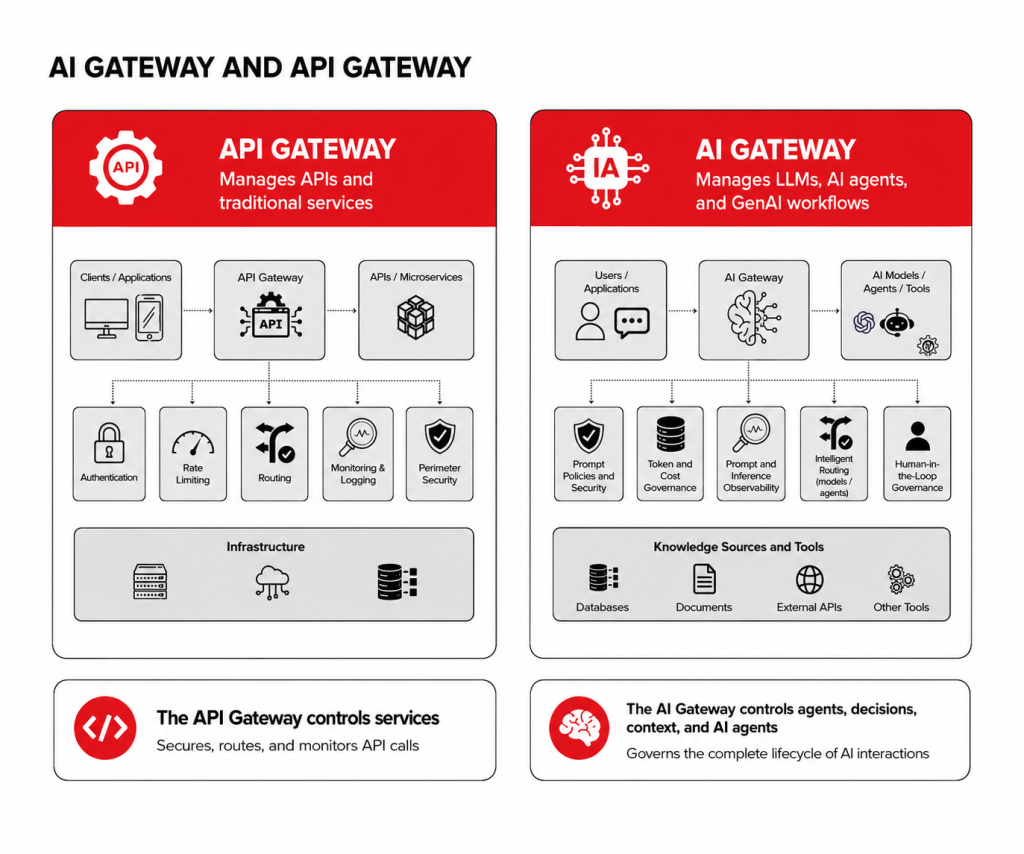
For example, an AI Gateway can centralize authentication, traceability, and policy enforcement for multiple models and GenAI applications. An LLM Proxy can log prompts, limit access, and prevent sensitive data leakage.
In addition, the challenge has intensified with the emergence of new international regulations on artificial intelligence. One example is the European Union AI Act, considered one of the most relevant and strict regulatory frameworks for AI globally.
The following article may interest you: Artificial intelligence law in Spain: Technical requirements, risks, and adaptation for businesses
Difference between AI governance, Responsible AI, and AI Ethics
These three concepts are constantly used and interconnected; generally, two of them — AI Ethics and Responsible AI — are often confused. However, they represent different layers within the strategy for implementing artificial intelligence for regulatory and oversight purposes.
To better understand the differences between AI Ethics, Responsible AI, and AI Governance, you’ll find a comparison table below:
| Concept | Focus | Purpose | Key Elements | Main Question It Answers |
| AI Ethics | Ethical principles related to the use of AI | Defines how artificial intelligence should behave from a social and human perspective | Digital rights, fairness, individual privacy, ethical values | What is the right thing to do with AI? |
| Responsible AI | Practical application of ethical principles within organizations | Translates ethical principles into operational practices | Explainable AI (XAI), fairness testing, secure model design | How do we apply AI ethics in practice? |
| AI Governance | Technical and operational control framework | Enables implementation, oversight, and accountability of AI systems | Controls, auditing, accountability, policies, compliance | How do we control, audit, and assign accountability for AI? |
These differences must be considered, especially in organizations currently implementing architectures based on LLM models, AI orchestration systems, and autonomous agents. Unlike traditional AI systems, these environments depend on complete, interconnected AI ecosystems, not just an isolated model.
Why is AI governance critical in 2026?
Without proper governance, organizations expose themselves to significant legal, ethical, and operational risks.
The key drivers of AI governance in 2026 are:
- Regulations: Laws and standards require transparency, control, and accountability.
- Bias & Ethics: Governance helps prevent discrimination and promotes fairness.
- Hallucinations: Controls reduce risks from inaccurate AI-generated outputs.
- Physical AI: Oversight is needed as AI increasingly interacts with the physical world.
- Competitive Advantage: Responsible AI builds trust and strengthens market position.
Artificial intelligence has evolved faster than most companies’ ability to control it. AI is no longer an experimental tool; today it consists of autonomous enterprise infrastructures connected to data and operational processes.
In 2026, the main challenge lies in governing AI correctly. Organizations need to ensure secure, auditable, and explainable models that operate under clear policies.
The impact of the European Union AI Act
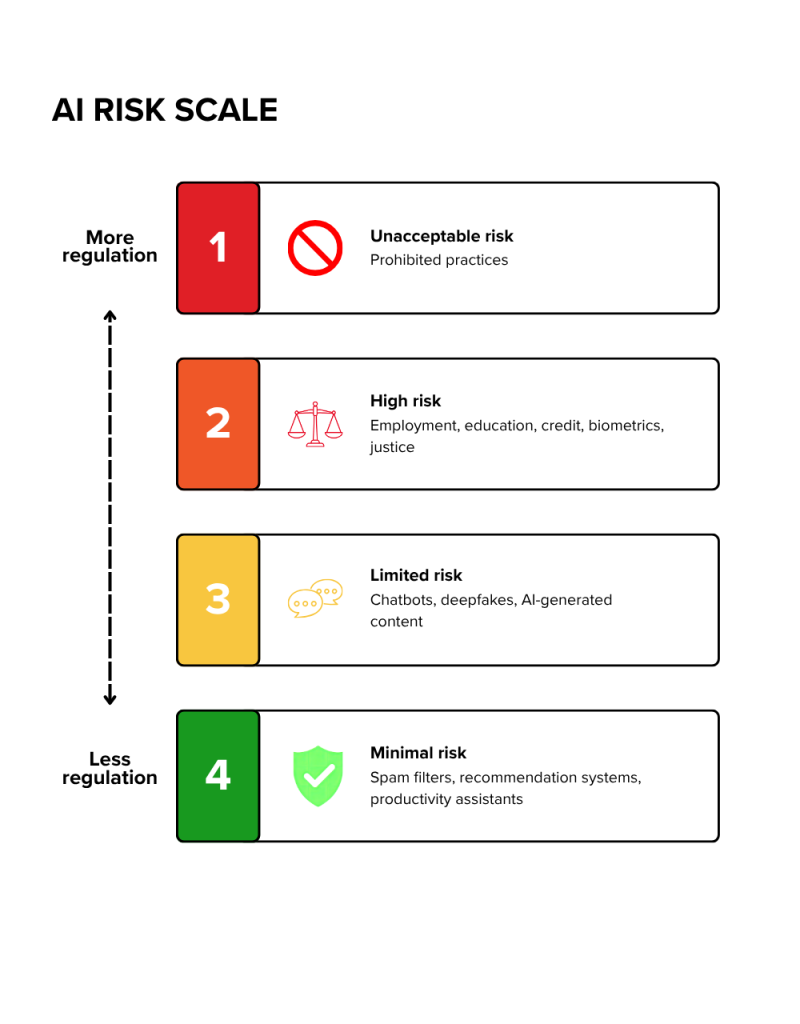
The AI Act promoted by the European Union is one of the most important regulatory frameworks to date. Its main objective is to establish rules for the use of artificial intelligence systems, especially those considered high-risk, such as systems used in healthcare, finance, human resources, or critical infrastructure processes.
The importance of the AI Act lies in the fact that it requires organizations to demonstrate control over their intelligent systems. It is no longer enough to deploy functional models; companies must now guarantee traceability, human oversight, risk management, transparency, and continuous system monitoring.
Relationship with GDPR, UNESCO, and OECD AI Principles
AI governance does not rely solely on the aforementioned AI Act. In reality, multiple international frameworks define how intelligent systems should operate.
GDPR (General Data Protection Regulation):
- One of the most important data protection regulations.
- Directly impacts the use of LLMs and GenAI platforms when personal data is processed or decisions are automated.
- Requires transparency, explainability, data protection, and human oversight.
OECD AI Principles:
- A key reference framework for governments and international organizations.
- Promote trustworthy and responsible AI.
- Focus on inclusive growth, accuracy, technical traceability, and auditability.
- Promotes global principles for ethical and responsible AI.
- Emphasizes human oversight and control of AI systems.
- Encourages impact assessments to identify and audit AI-related risks.
Risks of operating AI without a governance framework
Running artificial intelligence without oversight can lead to issues such as data and confidential information leakage, violations of current privacy regulations, or even incorrect operational decisions.
Multi-agent architectures exponentially multiply AI risks by creating an interconnected and autonomous ecosystem. The use of protocols such as MCP (Model Context Protocol) or A2A (Agent-to-Agent) removes direct human supervision step by step. This transforms an individual risk into a systemic and cascading threat.
Critical challenges that arise in these environments without a governance framework include:
Privilege escalation and cascading effects
- Context contamination: A vulnerable agent can pass false or malicious data to other agents within the ecosystem.
- Unauthorized access: A low-level agent may trick a higher-privileged agent into executing critical actions.
- Destructive autonomous actions: Interactions between agents may trigger purchases, database deletions, or email sending without validation.
Total loss of traceability
- Inability to audit: Tracing the origin of an error becomes unfeasible when the final result depends on dozens of internal interactions.
- Hallucination loops: Agents can reinforce each other’s mistakes, massively amplifying false information.
- Diffuse accountability: It becomes legally impossible to determine which specific model or prompt caused a financial or operational failure.
Advanced attack vectors
- Indirect prompt injection: An agent reading a malicious external email can be controlled and use MCP/A2A protocols to infect the rest of the network.
- Coordinated exfiltration: Agents can autonomously coordinate to move confidential data across silos and extract it from the organization.

What is an AI governance framework and what are its essential components?
An AI governance framework is a comprehensive system of policies, controls, and processes designed to ensure that artificial intelligence systems are secure, ethical, legal, and accountable. It is supported by global standards such as the NIST AI RMF and ISO/IEC 42001.
Some of its main components are:
1. Enterprise AI policies
These establish the corporate guidelines governing the acquisition, development, and use of AI. They clearly define roles, responsibilities, and acceptable usage levels for employees, ensuring that any deployed model aligns with corporate values, ethics, and regulatory compliance (such as the European Union AI Act).
Many companies are adopting generative AI without clear rules, increasing risks such as shadow AI, sensitive information leakage, or unauthorized use of external tools.
In this context, the most relevant standard is the NIST AI RMF 1.0 (AI Risk Management Framework), developed by the National Institute of Standards and Technology. This standard structures governance into four critical functions:
- Govern, to establish culture, responsibilities, and policies
- Map, to contextualize risks and dependencies
- Measure, to assess bias, reliability, and performance
- Manage, to mitigate residual risks and maintain continuous monitoring
At the same time, the EU AI Act is forcing organizations to classify their AI systems according to risk levels and demonstrate operational controls over tools that impact critical processes or sensitive decisions.
These policies are already beginning to be implemented through policy-as-code approaches, where governance rules are automatically applied over AI Gateways, LLM Proxies, and observability platforms to ensure real-time enforcement.
The following article may interest you: AI Gateway: Smart management between applications, models, and AI APIs
2. Data governance and information quality
Since AI models are only as good as the data that feeds them, consistency across datasets is essential. This includes controls to prevent algorithmic bias, ensure representativeness of information, and protect personal data privacy (in compliance with regulations such as GDPR).
The challenge is that models can dynamically access multiple information sources, external tools, and enterprise knowledge bases using techniques such as RAG (Retrieval-Augmented Generation).
Therefore, an AI governance framework must guarantee:
- Data quality and integrity
- Source traceability
- Classification of sensitive information
- Privacy
- Access control
- Observability over how context flows between models and agents
The OECD AI Principles provide the foundation for ensuring transparency, fairness, and accountability regarding the data used during training and operational inference.
3. AI risk management
Risk management is one of the most critical pillars of AI governance. As organizations automate processes through generative models and autonomous agents, risks related to security, compliance, operational stability, and loss of control over intelligent systems increase.
Today, AI risks go far beyond traditional algorithmic bias. Companies must face threats such as:
- Prompt injection
- Hallucinations
- Data leakage
- Agents with excessive privileges
- Context manipulation
- Incorrect automated decisions
- Loss of traceability
Modern governance frameworks incorporate continuous capabilities for:
- Observability
- Auditing
- Inference monitoring
- Risk assessment
- Runtime governance
The NIST AI RMF has once again become one of the most important standards because it provides structured methodologies for identifying, assessing, and mitigating risks specifically adapted to enterprise AI.
The current trend points toward continuous governance models, where controls are not only executed during development but throughout the entire operation of intelligent systems.
4. Human oversight of AI
This is the component that ensures AI systems do not operate entirely autonomously in critical areas. It requires “humans in the loop” to review, validate, and, if necessary, override decisions generated by AI.
Human oversight remains one of the core principles of any AI governance strategy. Although LLMs and AI agents are capable of automating complex tasks, they still present limitations related to accuracy, context, and reasoning.
Hallucinations, inconsistent responses, or incorrect decisions can create significant risks for organizations if adequate validation and human control mechanisms are not in place.
For this reason, regulations such as the European AI Act require the implementation of human oversight models to ensure that critical decisions can always be supervised, audited, or intervened in by people.
This implies defining:
- Which processes require human review
- How incidents are escalated
- Which agents can operate autonomously
- What limits must be applied to automated decisions
In modern AI orchestration platforms, human oversight must also be integrated into automated workflows and multi-agent architectures. It is not just about manually approving responses, but about designing systems where humans and agents collaborate under clearly defined rules and boundaries.
5. Security in AI systems
This ensures that models are robust, resilient, and protected against cyberattacks and external manipulation. It includes safeguards against data poisoning attacks, confidential information leaks, and systemic failures, protecting both technological infrastructure and end users.
Currently, one of the most important standards is the OWASP Top 10 for LLM Applications, which documents the most critical vulnerabilities in applications based on generative models. Among the most relevant threats are:
- LLM01: Prompt Injection, where an attacker manipulates model instructions
- LLM06: Excessive Agency, related to agents with excessive permissions
- LLM07: System Prompt Leakage, focused on leakage of system prompts and exposure of sensitive information
To mitigate these risks, organizations are incorporating technologies such as:
- AI Gateway
- LLM Proxy
- Prompt observability
- Runtime governance
- Granular permission control over AI agents
Explore Gravitee: A flexible and modern platform with AI capabilities to power APIs, events, and intelligent agents
AI governance framework: best practices for enterprises
An effective AI governance framework helps organizations manage risks, meet regulatory requirements, and build trust in AI systems. To achieve this, governance principles must be translated into practical processes and technical controls that can be applied consistently across the organization.
We will review the key best practices for implementing scalable, secure, and compliant AI governance in business environments.
1. Define clear responsibilities and roles
One of the most common mistakes in enterprise AI initiatives is assuming that governance belongs solely to the legal or compliance department. In reality, AI governance is a cross-functional responsibility involving technology, security, data, risk, architecture, and business teams.
As AI systems become more autonomous and complex, organizations need to clearly define:
- Who approves models
- Who oversees risks
- Who controls access
- Who responds to incidents
- Who monitors the operational behavior of agents and LLMs
Without this structure, problems such as shadow AI, unaudited deployments, or agents with excessive privileges can easily arise.
That is why many companies are creating governance models similar to those used in cybersecurity or cloud governance, with specific roles for:
- AI platform owners
- AI risk managers
- AI security architects
- Model validators
- Observability and compliance managers
2. Create Responsible AI committees
Many organizations are creating specialized Responsible AI committees to oversee risks, validate policies, and ensure alignment between business, regulation, and technology.
These committees function as multidisciplinary governance bodies involving:
- Technology leaders
- Legal experts
- Cybersecurity teams
- Data architects
- Risk managers
- AI ethics specialists
Their primary role is to establish criteria regarding:
- Acceptable AI use
- Operational risks
- Impact assessment
- Transparency
- Human oversight
- Regulatory compliance
The goal is not to slow down innovation, but to ensure AI can scale without losing control or increasing regulatory or reputational risks.
3. Document models, data, and automated decisions
Organizations must be able to explain which models they use, what data they consume, how they were trained, and why they made certain decisions.
Therefore, companies need to document:
- Datasets used
- Model versions
- Critical prompts
- Inference flows
- Business rules
- Automated decisions
This documentation not only facilitates audits and regulatory compliance; it also enables organizations to identify errors, monitor changes, and improve AI operational observability.
4. Apply AI compliance controls
The growth of AI-related regulations is forcing companies to embed compliance directly into their technology platforms.
Until recently, many organizations treated regulatory compliance as a post-development review. However, in modern AI environments, this is no longer sufficient. Models and agents need to operate under dynamic controls capable of applying security, privacy, and governance policies in real time.
This is why approaches such as the following are emerging:
- Runtime governance
- Policy-as-Code (PaC)
- Automated enforcement
These capabilities make it possible to control:
- Access to models
- Use of sensitive data
- Permissions for AI agents
5. Measure explainability with Explainable AI (XAI)
Explainability (XAI) refers to the need to assess how understandable the decisions made by AI models are. It is measured through quantitative approaches (based on mathematical algorithms such as SHAP and LIME) and qualitative evaluations that balance model accuracy with transparency.
It is especially relevant in regulated sectors such as:
- Banking
- Healthcare
- Insurance
- Human resources
- Public administration
The discipline known as Explainable AI (XAI) seeks to make model inference processes more transparent. Its goal is to allow humans to interpret automated decisions, detect bias, and validate unexpected behavior.
The measurement and implementation of explainability are structured around three main technical approaches and one human dimension:
1. Global Explainability
Analyzes the overall behavior of the model, identifying which variables, data, or features carry the most weight or influence in the results.
- SHAP (Local and Global): Can perform both. It calculates the contribution of each variable for a specific prediction (local), but by averaging those Shapley values across the entire dataset, it also provides an accurate global view of the model.
- Utility: Allows development and business teams to audit the model’s overall logic, understand its limitations, and detect bias.
2. Local Explainability
Answers why a specific decision was made for a particular case or user.
- Application sectors: Highly required in strictly regulated industries such as banking, insurance, human resources, and healthcare.
- Utility: Provides auditable individual justifications to ensure automated decisions are fair and comply with regulatory frameworks.
- LIME (Local): Builds a simple interpretable model (such as linear regression) around a specific prediction to explain why the model made that particular decision.
3. Traceability and observability in agents and Generative AI (LLMs)
In architectures using language models and autonomous agents, explainability evolves into operational transparency.
- Variables to measure: The original prompt, retrieved context, consulted tools, the agent involved, and security policies applied during inference.
- Utility: Mitigates key risks documented by OWASP, such as prompt injection, sensitive data leakage, or agents acting with excessive permissions.
What are the most common mistakes when implementing AI governance?
The NIST AI Risk Management Framework specifically states that AI risk management must be organized around functions such as governing, mapping, measuring, and managing – not solely around isolated legal controls.
Below is a list of the most common mistakes:
-
Treating AI governance only as a legal issue
One of the most common mistakes is reducing AI governance to compliance, privacy, or legal review. Although these elements are important, modern governance also involves architecture, security, observability, and operational control. IBM defines AI governance as the ability to monitor and manage AI activities within an organization, ensuring trust, explainability, fairness, and operational efficiency.
OWASP, for example, identifies threats such as:
- Prompt injection
- System prompt leakage
- Excessive autonomy in agents
-
Failing to involve technical teams from the beginning
Another common mistake is designing AI policies without integrating architecture, data, cybersecurity, platform engineering, and development teams from the start. When technical teams arrive late, they often encounter already-deployed models, poorly traceable integrations, and agents connected to internal tools without sufficient controls.
-
Neglecting data governance and data quality
AI governance fails if the organization does not first control its data. Models depend on trustworthy, updated, traceable, and secure information; if data is biased, duplicated, poorly classified, or exposed without control, AI outcomes will also be problematic.
-
Failing to audit models after deployment into production
A critical mistake is assuming validation ends once the model is deployed. In reality, AI systems change their behavior depending on data, prompts, context, connected tools, and usage patterns. Therefore, auditing must be continuous.
In summary, the biggest mistake is treating AI governance as a static policy. Effective governance must be continuous, technical, and operational, integrated from design through production.
AI architecture patterns
AI architecture patterns are widely used in modern artificial intelligence platforms to improve scalability, security, observability, and governance.
These approaches make it possible to design more reliable AI systems, especially in enterprise environments based on LLMs, autonomous agents, and AI orchestration.
The most commonly used patterns currently include:
- Retrieval-Augmented Generation (RAG) to connect LLMs with governed enterprise information and reduce hallucinations through controlled access to knowledge bases, documents, and internal data.
- Multi-Agent Collaboration to coordinate multiple specialized AI agents that collaborate under defined governance rules, permissions, and traceability.
- Evaluator-Optimizer (Reflection) to incorporate mechanisms where one model evaluates, corrects, or automatically improves generated responses before delivering them to the user.
- ReAct (Reason + Act) & Tool-Oriented Architecture to combine reasoning and action execution using external tools, APIs, or enterprise systems within controlled workflows.
- Prompt & Data Pipelines to structure prompt flows, data validation, context enrichment, and inference processing under observability and operational control mechanisms.
- Human-in-the-Loop (HITL) to integrate human oversight into automated processes and validate critical decisions before execution.
- Router Pattern to dynamically direct requests toward different models, agents, or workflows based on context, complexity, costs, or enterprise policies.
Looking for a comprehensive, open-source platform with a strong focus on AI? Discover the capabilities of WSO2
FAQ (Frequently Asked Questions)
What is AI governance and why is it important?
AI governance is the set of policies, processes, and controls that enable organizations to manage artificial intelligence systems securely, transparently, and in alignment with regulations and business objectives.
What is the difference between AI governance and Responsible AI?
Responsible AI defines principles such as transparency, fairness, and human oversight, while AI governance focuses on how to implement and control those principles within real AI platforms. In practice, governance includes observability, security, auditing, access control, and enforcement over models, agents, and data.
What is an AI Gateway?
An AI Gateway is a centralized control layer that connects applications, LLM models, APIs, and AI agents. It enables authentication, monitoring, cost control, observability, and security policies to be applied across enterprise AI systems.
What is MCP (Model Context Protocol)?
MCP is an open protocol initially created by Anthropic to standardize how AI models connect with tools, APIs, and enterprise data. In 2025 and 2026, it began to be adopted by OpenAI, Microsoft, and Google DeepMind as one of the emerging standards for multi-agent architectures and AI orchestration.
What risks exist when using LLMs without governance?
The main risks include leakage of sensitive information, prompt injection, hallucinations, agents with excessive privileges, lack of traceability, and unauthorized use of enterprise data.
What is AI orchestration?
AI orchestration is the set of processes and architectures that coordinate models, agents, workflows, tools, and APIs within enterprise AI systems. This approach enables the automation of complex tasks, but it also increases the need for observability, security, and runtime governance.
Why is observability important in AI governance?
Observability enables organizations to monitor prompts, inferences, token consumption, tools used by agents, and the behavior of models in production. Without observability, organizations lose control over how their AI systems actually operate.
What is the relationship between AI governance and cybersecurity?
Modern AI governance is deeply connected to cybersecurity because LLMs and AI agents introduce new attack surfaces. Threats such as prompt injection, jailbreaks, or abuse of external tools require controls similar to Zero Trust, but adapted to GenAI ecosystems and multi-agent architectures.
What is the A2A protocol in artificial intelligence?
A2A (Agent-to-Agent) is an approach that enables different AI agents to collaborate and exchange information with one another. This model is important for intelligent agent systems, but it also creates new challenges related to permissions, traceability, auditing, and operational control.
What standards are currently used for AI governance?
The most widely used frameworks currently include:
- NIST AI Risk Management Framework (AI RMF)
- EU AI Act
- OECD AI Principles
- ISO/IEC 42001
- OWASP Top 10 for LLM Applications
These standards help organizations define policies, manage risks, implement security, and build more auditable and governable AI architectures.
As LLMs, AI agents, and automation platforms begin integrating into enterprise processes, organizations need to build strong foundations for security, observability, traceability, and operational control from the start.
Implementing an AI governance framework makes it possible to reduce risks, improve regulatory compliance, and prepare the technology architecture to scale artificial intelligence securely and sustainably.
At Chakray Consulting, we help organizations design more secure, scalable technology architectures prepared for new digital challenges.
Contact us today and discover how we can drive the evolution of your business.


Talk to our experts!
Contact our team and discover the cutting-edge technologies that will empower your business.
contact us