API Sprawl is the uncontrolled, invisible, and decentralized proliferation of Application Programming Interfaces (APIs) within an organization’s technological infrastructure.
While this organic growth previously operated at a manageable pace, coding assistants like GitHub Copilot, ChatGPT Enterprise, and Cursor have turned it into an exponential expansion. Today, organizations manage more endpoints with less governance, exposing themselves to critical regulatory risks.
In this article, we will detail the impact of AI on integration security, review the current regulatory framework, and explain how to implement a preventive framework from the software development life cycle to secure your architecture.
AI-accelerated API sprawl: a quantifiable challenge
Currently, a single developer backed by Artificial Intelligence can deploy dozens of endpoints in a single day. If organizations lack visibility into how this code is being generated, cybersecurity teams are forced to adopt a purely reactive stance against vulnerabilities. If your company is already facing these challenges, the integration experts at Chakray can help you regain technological control.
Industry data backs up this urgency. A large-scale security scan conducted by Escape.tech on over 5,600 applications reveals that the footprint of AI-generated code is constantly increasing. The direct impact is quantified by Veracode‘s 2025 GenAI Code Security Report, warning that 45% of this code introduces vulnerabilities detected in audits.
Furthermore, the State of API Security report by Traceable.ai indicates that large corporations are unaware of between 10% and 20% of their active APIs, creating a severe exposure window from the connection’s creation until its eventual detection.
Case study: agile implementations, failed audits
To illustrate the operational impact, let’s analyze the case of a large engineering firm that adopted coding assistants to streamline its deliveries.
The initial result was a 35% increase in development speed during the first quarter. However, by the second quarter, technical debt had doubled. Dozens of active endpoints surfaced without documentation or security audits, and architectural reviews began to be bypassed as they were considered a bottleneck to productivity.
The financial impact on the company was considerable, requiring over 14 weeks of intensive work to remediate the vulnerabilities. The greatest aggravating factor was the discovery of dozens of uncatalogued connections, which led to penalties during external compliance audits.
Methodological governance vs. platform configuration
Implementing a centralized inventory or an API Gateway is a necessary step, but insufficient on its own. Leading solutions like Gravitee, WSO2, or APISIX are fundamental for centralizing traffic and enabling data export under the OpenAPI standard.
The risk arises when API governance resides exclusively within the configuration of these tools. If the technical team rotates or a technological migration occurs, security knowledge and access policies can be lost.
The solution lies in establishing a methodological framework independent of the software used. A model where the company maintains institutional ownership of the catalog and where security guidelines are structurally integrated into the Software Development Life Cycle (SDLC). Integration governance must be consolidated as a corporate discipline, not as a feature delegated to third parties.
2025 regulatory framework: OWASP LLM, NIST SP 800-218A, and the European AI Act
Uncontrolled development has transcended the purely technical realm to become a legal and regulatory risk.
- OWASP LLM Top 10 (2025): Defines the inherent risks in integrating Large Language Models (LLMs). Categories such as Insecure Output Handling apply directly to auto-generated code.
- NIST SP 800-218A: Published on the official NIST portal (July 2024 at nist.gov), this standard formalizes the specific security controls that must be applied to AI-generated code.
- EU Artificial Intelligence Act (AI Act): The new European regulation establishes strict requirements for cybersecurity, traceability, and human oversight, directly complementing critical directives like DORA and NIS2.
For companies subject to these regulations, auditing code and its automated integrations is an unavoidable obligation.
Automated auditing in the SDLC (Security Playbook)
The foundational prerequisite is to maintain a centralized catalog based on OpenAPI 3.1. Without this single source of truth, security controls lack a valid reference point. From this foundation, return on investment is secured by implementing sequenced controls directly into the SDLC pipeline.
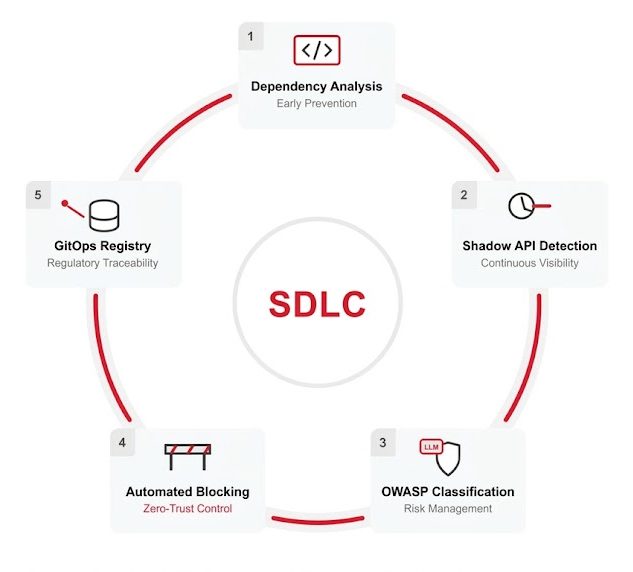
5-Phase Software Development Life Cycle (SDLC) Circular Diagram to Govern API Sprawl
Zero-Trust implementation phases
- Phase 1 (Early Prevention): Automated dependency analysis of the code prior to deployment.
- Phase 2 (Continuous Visibility): Detection of Shadow APIs by scanning repositories and network traffic during the Continuous Integration and Continuous Deployment (CI/CD) process.
- Phase 3 (Risk Management): Classification of each new integration using the OWASP risk taxonomy.
- Phase 4 (Zero-Trust Control): Automated blocking of the release to production if the integration fails to meet corporate security policies.
- Phase 5 (Regulatory Traceability): Immutable recording of governance in versioned Git artifacts, ensuring auditability against regulations such as DORA or NIS2.
Hybrid architecture and emerging entities in 2026
A resilient architecture must combine open standards (OpenAPI, AsyncAPI), a GitOps approach to avoid vendor lock-in, and orchestration with Kubernetes. Added to this is OpenTelemetry to ensure auditable end-to-end observability, applying Zero-Trust authorization through mTLS and Attribute-Based Access Control (ABAC).
On the near horizon, protocols like the Model Context Protocol (MCP) and Machine Identities are transforming the ecosystem. As AI agents begin to orchestrate interactions autonomously, traditional authentication standards like OAuth will require more robust security architectures.
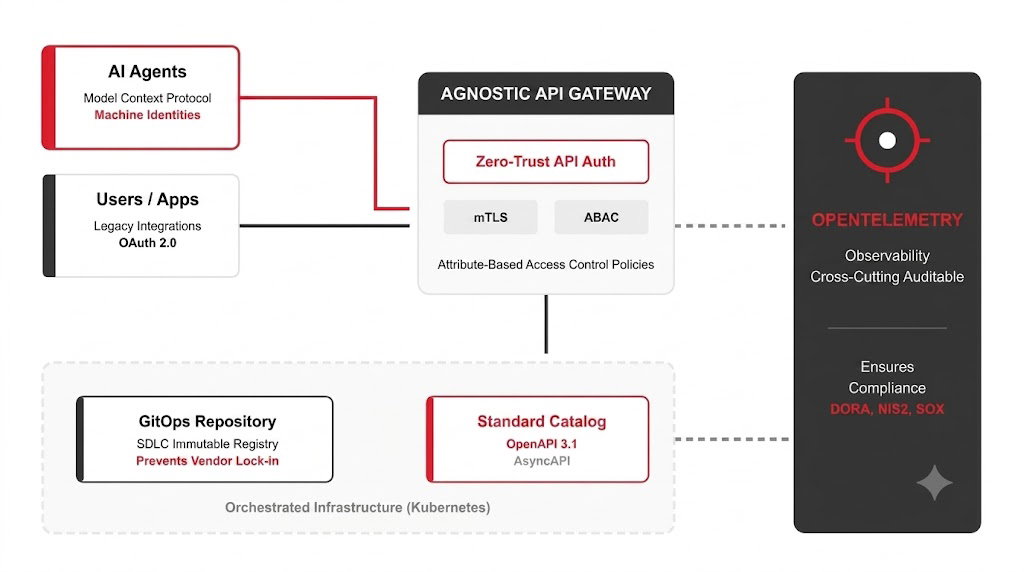
Hybrid architecture diagram for API governance
Comparison: operational capacity
Below, we summarize the operational advantages of implementing a hybrid methodological governance versus the limitations of a native approach based solely on the platform:
| Capacity | Native platform approach | Hybrid methodological governance |
| Shadow API detection | Reactive post-deployment scanning | Structured prevention in the SDLC pipeline |
| NIST SP 800-218A compliance | Lack of direct regulatory coverage | Immutable traceability in auditable artifacts |
| Resilience to staff turnover | Knowledge tied to the departing vendor | Fully transferable institutional ownership |
Take control of your API ecosystem with Chakray
The adoption of Artificial Intelligence to accelerate software development is an irreversible competitive advantage. However, architectural chaos and penalties for regulatory non-compliance are avoidable. In a scenario where AI Agents will interact autonomously with corporate systems, maintaining a manual API inventory is operationally unfeasible and legally unsustainable.
At Chakray, we specialize in designing, implementing, and governing complex and highly resilient integration ecosystems. Beyond technological enablement, we help organizations to:
- Deploy market-leading API gateways, adapted to your infrastructure (working with partners such as WSO2, Gravitee, among others).
- Design a culture of methodological governance independent of the provider, ensuring that ownership and knowledge remain within your company.
- Automate security in your Software Development Life Cycle (SDLC) to ensure regulatory compliance demanded by global regulators.
Does your organization need to regain control over AI-generated integrations? Do not wait for an audit to identify your Shadow APIs.
Talk to Chakray today and discover how to centralize, secure, and scale your technological architecture securely and reliably.
FAQ
What is the difference between API sprawl and integration technical debt?
API Sprawl (proliferation) is the visible overabundance of uncontrolled connections and endpoints. Technical debt is the operational, financial, and security cost assumed by the company in attempting to maintain those assets without adequate governance.
How can an organization detect AI-generated APIs?
By implementing continuous security scans in workflows (CI/CD), analyzing the source code, and monitoring actual network traffic to compare it against the company’s official catalog (OpenAPI).
What metrics indicate an immediate audit risk?
A ratio of documented APIs versus active APIs below 0.8, or a quarterly increase of more than 20% in unregistered connections, are clear indicators of a governance deficit.
How is the NIST standard translated into real operations?
By auditing AI-generated code prior to deployment, classifying its risk level using OWASP standards, and automating blocks in the pipeline to prevent software that violates corporate policies from reaching production.


Talk to our experts!
Contact our team and discover the cutting-edge technologies that will empower your business.
contact us